Application to weigh cattle by mobile with AI in real time
Announcements
Weighing cattle quickly and accurately is critical for those working with livestock, whether on small farms or in large herds. Currently, you can do this directly from your Android phone using artificial intelligence applications that measure weight in real time, eliminating the need for expensive and laborious conventional scales.
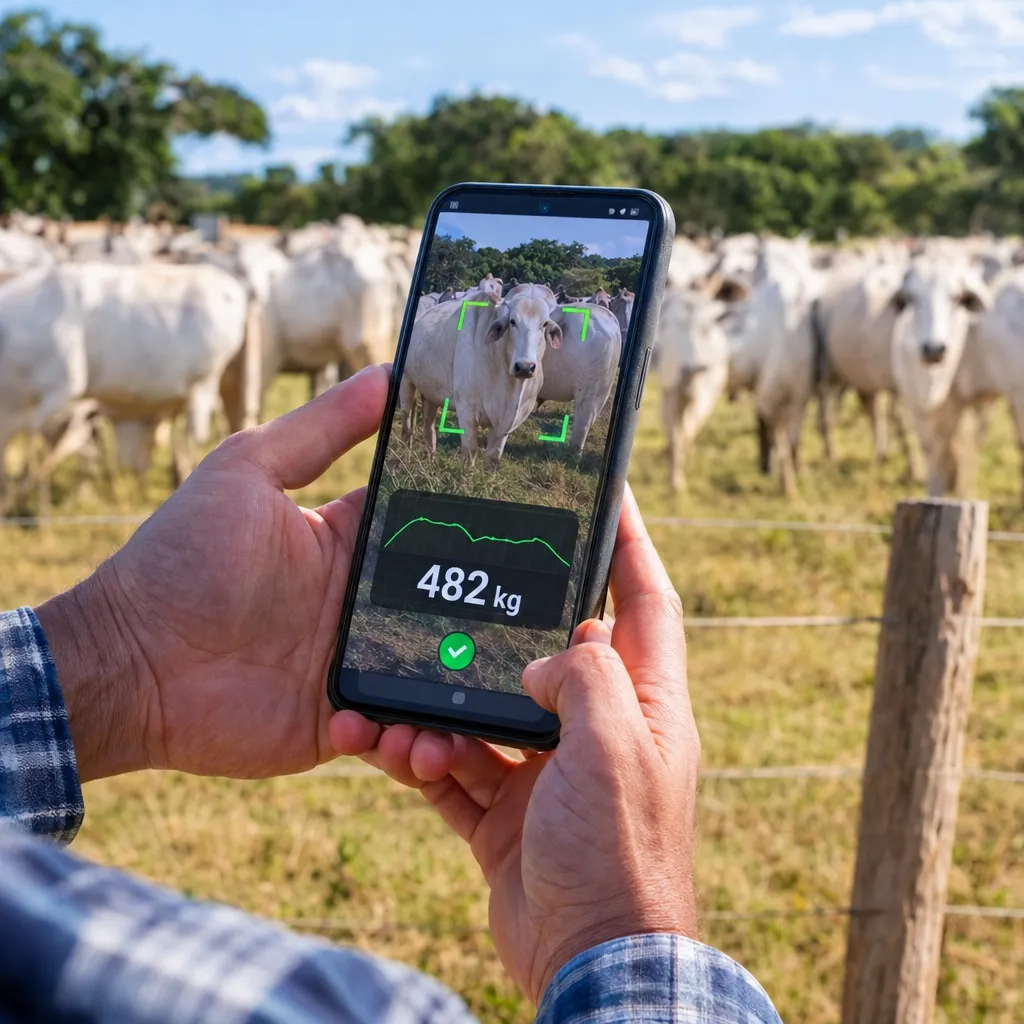
Modern applications use camera and AI to estimate the weight of the animal just by photographing or filming, offering instant results.This revolution has reached the pocket of those who work with cattle, making livestock more efficient and accessible to producers of all sizes.
What is really a cattle weighing app with AI
An artificial intelligence livestock weighing app works by capturing images of the animal through the camera of your Android phone. It analyzes body proportions, compares with database of breeds and characteristics, and generates an estimate of weight in a matter of seconds.
Announcements
The technology uses computer vision and machine learning algorithms to identify specific biometric patterns of cattle. The system recognizes race, sex, approximate age and body condition, using this information to calculate weight with relatively low margin of error. Different applications use different approaches, but the fundamental principle remains the same: turn visual data into accurate estimates.
Myth: AI never makes a mistake when weighing cattle
Many believe that artificial intelligence always provides perfectly accurate results, which is a dangerous illusion for those who depend on this data commercially. In reality, applications weighing cattle with AI have margin of error ranging between 5% and 15%, depending on the quality of the camera, lighting, positioning of the animal and accuracy of the algorithm. A 500 kg ox can have its estimate ranging between 425 and 575 kg.
 Animal Weight – Pigs and Cattle
Classification:
^^^^^^^^^^^^^^^^^^^^^^^”’
3.75
Age Classification:
Free Classification
Author:
HorDev
Platform:
Android
Price:
Free
▶Download on Google Play
Technology constantly improves, but external factors directly influence accuracy.If you photograph the animal with shade on the body, from an inappropriate angle or in motion, the result will be less reliable.In addition, the databases of the applications train with animals of certain regions or breeds, which can impair accuracy when you work with less common genetics.Speakingly relying on a single AI-generated result is risky, especially in high-value transactions.
Truth: AI helps significantly in pre-screening and selection
Although not 100% accurate, artificial intelligence is extremely useful for pre-screening and rapid selection of animals. You can quickly identify which cattle are within the desired weight range, saving time in batches with hundreds of heads. For this purpose, a 10% margin of error is completely acceptable and significantly improves labor productivity.
On properties where you need to separate animals ready for slaughter from those that still need to gain weight, the technology speeds up this process impressively. You quickly photograph each animal as it passes the measurement, record the data in the application and generate a report in minutes. Without AI, this same process would take hours with tape measure and manual calculations, which are even more inaccurate than the technology itself.
Myth: the app completely replaces the cattle scale
Believing that a mobile app will completely replace a conventional scale is misleading, especially for large-scale business operations or when weight influences critical financial decisions.Traditional electronic scales offer accuracy of over 99%, while applications offer estimates that need validation.For animal purchase and sale transactions, most buyers still require confirmed weights on a certified balance.
What really happens is a complementarity between technologies. You use the application for internal management, herd development monitoring and quick sorting decisions. For official transactions, sales or records that will have legal value, you still need to go through the conventional scale. AI is a support tool that makes the routine more agile, not a complete replacement for calibrated and certified equipment.
The Android phone greatly simplifies data collection
The biggest real advantage of a livestock weighing app on Android is the democratization of data collection and integration with other management tools.You already carry a smartphone all the time, do not need investment in specialized equipment and can record information from multiple animals in quick sequence.The data can be synchronized in the cloud, shared with veterinarians and managers instantly.
In addition, you create a digital history of the development of each animal over time. Comparing photos and estimated weights month by month, a clear picture emerges of how its nutrition and management are working. This continuous documentation is practically impossible to do with traditional scales, where you write down data on paper and eventually lose information. With synchronized applications, your herd database is organized, accessible and reliable for future analysis.
Myth: camera quality of mobile phone does not matter in accuracy
Many ignore that the quality of the camera of your smartphone directly influences the results of the weighing application. This is a mistaken belief that leads to frustrating results. A cell phone with a low resolution camera (less than 12 megapixels) or with a lower sensor captures less biometric details of the animal, hindering the analysis of the algorithm and increasing the margin of error significantly. Superior quality cameras capture fine details of the body contour that make a real difference in estimates.
In addition to the megapixel, sensor quality, pixel size and autofocus capability also matter. An intermediate or input cell phone with basic camera can present error margins of 15% to 20%, while a top quality smartphone reduces this to 7% to 10%. If you are going to invest time in using an app of these characteristics, it makes sense to use a device with decent camera, as the result will be considerably better.
Truth: AI reduces operating costs for small and medium-sized producers
For those who work with small or medium-scale livestock, investing in conventional electronic scales can be costly, especially considering periodic maintenance and calibration. An AI application offers a low-cost alternative that offers sufficient precision for internal management decisions. Most applications are free or cost between R$ 10 and R$ 50 per month, an insignificant amount compared to investments in traditional equipment.
In addition to the initial financial aspect, you eliminate the need for fixed infrastructure such as corrals and installed scales.You can weigh animals anywhere using only your mobile phone, which offers operational flexibility impossible with conventional scales. For properties that practice pasture rotation or extensive management, this mobility is a considerable strategic advantage that positively impacts the overall productivity of the operation.
Myth: all livestock weighing apps offer the same accuracy
Believing that quality and accuracy are equal across all applications is misleading and can lead you to use inappropriate tools. Different developers train their algorithms with different databases, use different methodologies and have varying levels of investment in improvement. An application developed five years ago with outdated algorithms will perform significantly lower than another recently developed with advanced machine learning.
Some platforms specialize in specific breeds, offering exceptional accuracy for Nellore or Angus cattle, but poor results for less common breeds. Others try to be generic and offer median performance in all breeds. You need to research, test and compare different applications before integrating one into your routine. Read reviews from other farmers and do pilot tests with your own animals is essential before you put full trust in a tool.
Truth: AI significantly improves zootechnical control
A genuine and often underestimated benefit of using artificial intelligence applications is improved herd zootechnical tracking.You can monitor daily weight gain accurately enough to adjust nutrition, identify sick animals that suddenly lose weight, and validate that your diet is generating expected results.
Data-driven zootechnical control makes herd management more scientific and less intuitive.You quickly identify which batch of animals is having the best feed conversion, which nutrition works best for a given genetics, and when is the optimal time to increase or reduce feed. These decisions, when based on reliable data even if estimated, generate resource savings and increased productivity that quickly pay for any investment in technology.
Myth: AI works equally well in any lighting condition
Many believe that artificial intelligence can process images of animals equally well regardless of sunlight, shade or artificial lighting, which simply does not correspond to technical reality. Computer vision fundamentally depends on image quality, and shadows impair the analysis of the animal’s body contour. If you photograph an ox with half its body in the shade, the algorithm loses critical information for accurate estimation.
Poor lighting, strong backlights, or very direct light that creates abrupt shadows reduce the reliability of estimates significantly. For best results, you should photograph animals at times with diffuse side lighting, typically early morning or late afternoon.Shooting at noon with sun at zenith or at dark impairs the quality of catches. Understanding these technical limitations and planning your weighing routine considering proper lighting is essential to achieve consistency in results.
Truth: AI offers scalability for large herds
For properties with very numerous herds, where photographing each animal would be impractical, AI applications offer realistic solution through strategic sampling. You do not need to weigh all 500 cattle; weighs a representative sample of 50 or 100 animals and generates data on average development of the entire batch. This approach provides sufficient managerial visibility with minimal investment of time.
In addition, you can use AI to first quickly screen the entire herd, identifying only animals that deviate significantly from the expected average weight for more detailed investigation.This data-driven prioritization makes managing large herds much more efficient than trying to weigh or evaluate each animal individually. The technology scales well because the larger the herd, the greater the time and resource savings AI offers.
Myth: you must be connected to the internet to use the app
A common belief is that you need to be constantly connected to the internet to use AI weighing apps, which is not entirely true for most modern platforms.Many apps work offline, capturing the images and doing local processing on the smartphone.The data is synchronized with server as soon as you regain connection, without losing any captured information.
This offline functionality is crucial for farmers where connectivity is inconsistent or slow. You are not held hostage to signal quality when working in the pastures or corral. The application continues to work perfectly, you collect your data, and then synchronize everything when you return to the area with better connection. Check if the application you choose offers this capability is important, as many in fact require constant connectivity, which would be impractical in rural environments.
Truth: integration with other agricultural management systems is real
AI-powered livestock weighing applications do not live in isolation; many integrate with more comprehensive farm management software, creating a complete ecosystem of data about your property. You synchronize estimated weights with records for feed, medicine, reproduction and genealogy, generating a holistic view of the health and performance of each animal. This data integration is powerful for strategic decision making in modern livestock.
Some platforms allow data export in standard formats that connect with more robust agricultural ERP systems.This means that the weight data you collect with the application feeds more complex analyses of profitability, production efficiency and planning.For operations that work with multiple farms or complex management systems, this integration capability offers substantial strategic value, transforming simple weight data into applicable business intelligence.
Myth: AI learns and improves for your specific herd
While it is technically possible for an AI system to learn from the data you provide, most applications do not work that way. Algorithms are trained once by developers with extensive database of animals, and this model does not adapt to the specific patterns of your cattle. Believing that the more you use, the more accurate the application gets to your herd is a misleading expectation.
Exceptions exist for premium enterprise platforms that offer customized learning, but these are rare and costly. Conventional applications use frozen model that does not change as you collect data.If your herd has very specific genetic characteristics that differ from the training database, the application will never adapt better. You will have to deal with consistent error margins, which should be considered when planning how to use the tool.
Truth: you can validate the accuracy of the application by testing with traditional scale
The most reliable way to assess whether a weighing application is suitable for your operation is simple practical validation: weigh some animals with conventional scale and then with the application on the same day, comparing results. This empirical approach shows exactly what margin of error you expect for your specific conditions, breeds and environments. If the application estimates 500 kilograms and the scale scores 510, you know that there is 2% error, which is acceptable.
It is recommended to test with at least 20 to 30 animals of different sizes and types to obtain representative sample. Record the comparative results and calculate the standard deviation and mean error. If the mean margin is less than 10% and the variation is consistent, the application is likely reliable for your internal needs. If errors are random and large, the tool is not suitable. This simple test takes half an hour and eliminates much of the uncertainty about reliability.
Myth: AI recognizes animal health only by estimated weight
Believing that an application that estimates weight can diagnose diseases or assess health just by seeing the animal is dangerous. Artificial intelligence offers weight estimation based on external biometrics; this does not replace deep veterinary evaluation. An animal may have weight within the expected but be sick, malnourished or with parasites that are not visible in a quick photo. Mistaking weight estimation with health diagnosis is deception that can lead to harmful decisions.
Some apps offer additional body condition analysis or coat pattern functionality, adding limited but non-substitutive value to veterinary diagnosis. Use AI to monitor quantitative herd development, but maintain traditional animal health protocols with a qualified veterinarian.