Make Genealogical Tree by Mobile with App
Announcements
Discovering your roots and connecting with your ancestors has never been as accessible as it is now. With a family tree app on mobile, you can document your family history in minutes and access it from anywhere, anytime.
 PastLives
Classification:
^^^^^^^^^^^^^^^^^^””
3.15
Age Classification:
Classification 18 years
Author:
Mobi Connect Trek
Platform:
Android
Price:
Free
▶Download on Google Play
Technology has completely transformed the way we investigate our origins and keep the stories of our predecessors alive. Today, you no longer need papers scattered around the house, recorded conversations or uncomfortable visits to notaries to assemble your family tree. Modern applications offer sophisticated features that simplify this process and allow your whole family to participate in the construction of this historical narrative.
Why Make Your Family Tree Through an App
Assembling a family tree using an application offers advantages that traditional methods simply cannot achieve. You gain portability, data security and the possibility to share information with family members who live in different cities or countries, all within a single digital ecosystem.
Announcements
Immediate access is one of the big reasons why many people choose this approach. While you are in a family meeting or talking to an older relative, you can quickly write down the information directly on your mobile phone, without having to go looking for a notebook or paper. This facility significantly increases the quality and amount of data you can gather, as it reduces the chances of you forgetting important details later.
Security is also a deciding factor when choosing a well-developed app.Your genealogical data is encrypted and stored in the cloud, protected from physical loss, theft or accidental damage.You can synchronize this information across multiple devices and have the peace of mind of knowing that your family history is safe and accessible whenever you need it.
Comparative: Choosing the Best App for Your Need
There are dozens of family tree apps available in the app stores, but not all of them meet the same needs. Some focus on ease of use, others on advanced search capability, and some even offer access to massive historical databases. Understanding these differences is essential to choosing the right tool for your project.
The first criterion you should consider is the level of complexity your family tree will achieve. If you are just starting out and want to document three or four generations, any basic application works well.However, if you plan to research complicated lineages with multiple branches, marriages, divorces and complex relationships, you need an application that supports these scenarios without getting confused.
Some apps offer access to public databases and historical records that exponentially accelerate your search.These more robust platforms connect you with census information, immigration records, parish documents, and even DNA testing.If this depth of research is important to you, being willing to invest in a premium app makes all the difference.
The Different Types of Applications Available
There are basically three categories of genealogical applications that dominate the market. Understanding the characteristics of each one helps you make a more informed decision and avoid choices that do not align with your real goals.
Simple Input and Visualization Apps
These apps work like basic digital family trees where you manually enter names, birth dates, death, and family relationships.They offer clear tree-shaped views, allowing you to quickly see how everyone is connected. The advantage is simplicity and ease of learning, as virtually anyone can use without training.
These tools are ideal if you already have the information about your ancestors and just want to organize and view it clearly. They work well for small or medium families and allow you to print or share the tree with other family members. The disadvantage is that you need to do all the research manually, seeking information in old records, documents papers or conversations with relatives.
Apps with Integrated Search
These more advanced applications combine data entry functionality with access to public and historical genealogical databases.When you enter a person, the application can suggest records that match that person, saving hours of manual search.
The big difference here is the ability to discover information you would never have found on your own. The app connects you with scanned census documents, ship passenger lists, death records and more. For anyone who wants to go beyond the information the family knows and really investigate their origins, this category offers extraordinary value.
Community Collaborative Platforms
Some apps work like genealogical social networks, where you are not only creating your own tree, but also connecting with others who share your ancestors. These platforms have active communities where people collaborate, share discoveries, and even combine resources to search for complex family lines.
The advantage here is exponential: you take advantage of the work of others who have already researched their ancestors in common. If someone from your distant family has already created a detailed family tree, you can connect to it and potentially find valuable information that you did not know you were looking for. The disadvantage is that you need to be comfortable sharing familiar information on a public platform.
Essential Features You Should Look For
Regardless of the type of application you choose, there are fundamental functionalities that ensure a proper user experience and allow you to fulfill your genealogical goals.Knowing these features helps you compare options more securely.
Tree viewing is absolutely essential and should be clear and intuitive. You should be able to see at a glance how family members are connected, without needing complex explanations. A good visualization allows you to easily navigate from one relative to another, expanding or retracting branches as needed. Some applications also offer alternative views, such as timelines or lists organized by generation, which can be useful in different contexts.
The ability to add photos, documents and notes is absolutely valuable to preserve your family history.You can attach old photographs of your ancestors, scanned copies of birth certificates, letters and even audio recordings of family stories.This wealth of media turns your application from a simple list of names into a real historical file of your family.
Sharing with other family members should be simple and secure. Ideally, you should be able to invite specific relatives to collaborate on the tree, allowing them to add information, correct data, and share their own findings. A good permissions system ensures that you keep track of who sees what.
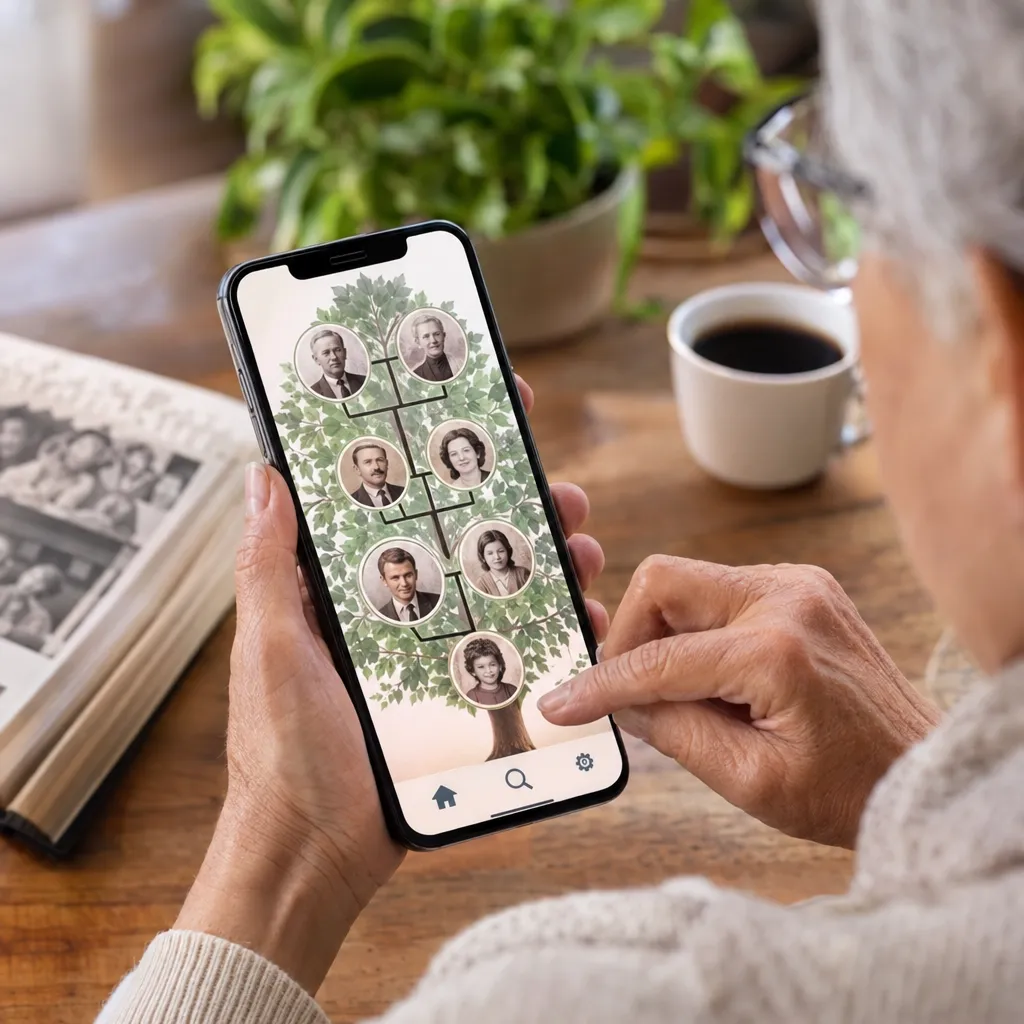
Automatic synchronization between devices is critical to convenience.You want to be able to update your information on your phone during a family conversation and have these updates available instantly on your tablet or computer. This synchronization should happen in real time or at least every few minutes.
Step by Step: How to Start Your Family Tree
Starting a family tree may seem intimidating, but the process is simpler than you might think.Dividing work into manageable steps turns a project that seemed impossible into something completely feasible.
Always start by yourself or the best-known generation, which is usually your parents. Enter their names, birth dates and any basic information you have at hand.Don’t worry about being perfectly accurate at this early stage, as you can always upgrade later.The goal is to create a basic structure on which you will build the rest.
Then add your grandparents and known uncles. Invite your parents or older family members to help review and supplement this information.Often, just talking to your older relatives, you will discover information you did not know, such as the full name of the grandmother, precise wedding dates or even interesting stories about why certain names were chosen.
Once you have established the first generations, start searching using any database available in your app. Look for records of your ancestors in censuses, immigration lists or other public documents. This search will be progressively easier as you have more information, as accuracy allows you to filter results better.
Organize your search by familiar lines. Work on one line as far as you can get, then switch to another. This approach keeps you organized and prevents you from getting lost in different branches simultaneously.Many people find that certain branches are easier to search than others, so switching between them keeps motivation.
Common Challenges and How to Overcome them
Even with the best tools, you will inevitably face challenges during your genealogical research. Understanding these obstacles beforehand and knowing strategies to overcome them avoids unnecessary frustration.
Lack of records is the most common challenge, especially when trying to trace lineages to periods prior to formalized government records.If you are facing this problem, consider using parish records, which often go back hundreds of years.Imigration records are also incredibly valuable, as many of them list entire families with names of relatives, professions, and geographical origins.
Duplicate or very common names present another frequent challenge. If you are looking for Joao da Silva in the nineteenth century, you can find hundreds of people with that name. The solution is to use additional information as context: the place where that person died, the name of the spouse, the profession or the approximate date. These layers of information help eliminate irrelevant results.
Conflicting information between different sources often causes confusion. One document may say that your grandmother was born in 1920, but another document says 1922. The correct approach is to document conflicting information and look for additional sources that clarify the truth.Often, small variations of dates occur because of transcription errors or inaccuracy in the original records.
Finding information about branches that immigrated to Brazil from another country requires searching databases from other countries. Fortunately, many genealogical applications have international partnerships that provide access to records from various countries.
Keeping Your Genealogical Tree Updated and Organized
Keeping your family tree organized and up to date ensures that your information remains valuable over time and that new discoveries are systematically incorporated.
Decide whether to use full or abbreviated names, how to handle names that have changed during life (weddings, migrations), and how to document known nicknames. Consistency in these conventions makes your tree much easier to navigate and reduces confusion when you return to it months later.
Create a system to track information sources. Whenever you add a fact to your family tree, record where that information came from. If you created an annotation based on a photocopy of a document, indicate this. If you talked to a relative, record the date of that conversation. This rigor in source documentation turns your tree into a serious work of historical research.
Regularly review your information with older family members. At each family meeting, take a few minutes to validate the information you have and ask for fill in for gaps. This not only ensures accuracy, but also involves your family in preserving your collective history.Many people get precious information by simply asking during a family meal.
Even if the application offers cloud synchronization, keep local copies on your computer.If the application disappears or you change service, you will have your data available in a format that can be recovered. Many applications allow export in standard formats such as GEDCOM, which is a universal framework for genealogical data.
Share your findings with your family strategically. As you uncover interesting information about your ancestors, create stories you can share with your family nucleus. These narratives turn your family tree from a dry document into a series of captivating stories that other family members will also want to research and contribute.
Your family tree is a project that can continue indefinitely.New generations will be born, new information will appear and your research can lead you to amazing discoveries about family members you have never met. Keeping your app up to date ensures that your family history remains a living and vibrant document that reflects who you are and where you came from.