App to learn piano from scratch on your Android with step by step lessons
Announcements
Learning piano on mobile is more affordable than ever, and you don’t have to spend anything to get started.There are specialized apps that offer structured lessons, interactive exercises, and progress tracking tools, allowing you to develop your musical skills from day one, even without previous experience.
In this article, you will discover how to choose the best app to learn piano from scratch on Android, understand what features are essential for beginners, and learn practical strategies to maximize your learning through the mobile screen.
Why learn piano through an Android app?
Mobility is the great asset of piano apps for beginners.You can study at work breaks, during breakfast or before bed, without relying on a teacher in person or investing in a physical instrument.The digital format democratizes access to music education, allowing anyone with an Android smartphone to start the musical journey today.
Announcements
In addition to practicality, these apps offer customization that few teachers can deliver. The algorithm adjusts the pace of lessons according to your performance, keeping the challenge while being frustrating. You receive immediate feedback on your grades, time and accuracy, which speeds up learning compared to traditional methods where feedback comes only once a week.
The gamification present in these applications keeps you motivated through achievements, medals and visual progression. Studying piano is no longer a boring obligation and becomes an engaging activity that you really want to do every day. This psychological aspect is fundamental for beginners who have not yet developed strong musical discipline.
 Simply Piano – Learn Fast
Classification:
”’I think it’S.
4.68
Age Classification:
Free Classification
Author:
Simply Ltd
Platform:
Android
Price:
Free
▶Download on Google Play
Essential features you should look for in a piano app
Not every piano app is suitable for beginners. Before installing any, you should know what features really matter to anyone who is starting from scratch. The first fundamental feature is the presence of structured and progressive lessons that teach basic theory, finger positioning and reading sheet music. A good app does not skip steps, starting from the very basic.
Audio quality is critical to learning music correctly.The app must produce clear and accurate piano sounds, differentiating each note properly. Low-quality sound impairs your auditory training and can create bad habits, making it necessary to relearn later.Make sure the app allows you to adjust the volume and offers different instrument tones.
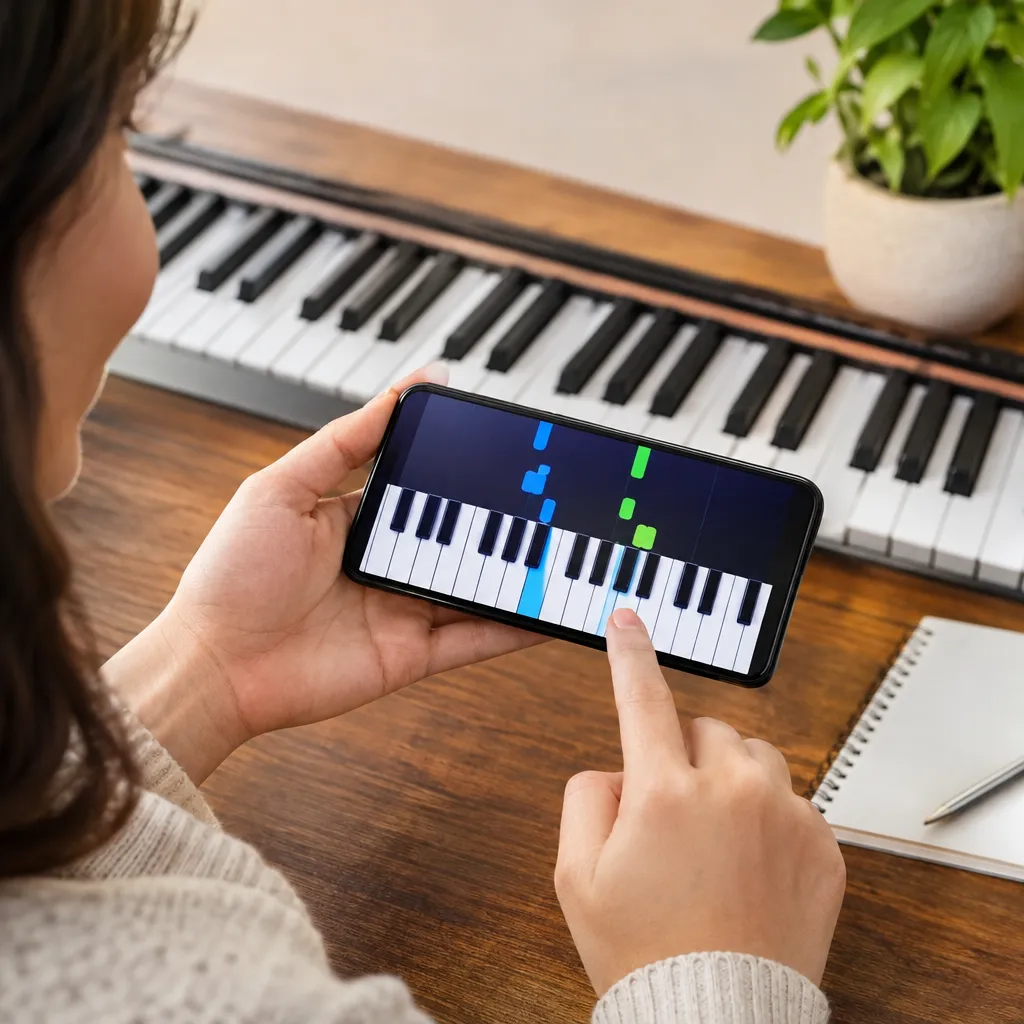
You need an app that offers visual feedback on your notes. This includes showing whether the note was played correctly, how many milliseconds it delayed or advanced, and whether the pressure was enough. Real-time visualization tools are especially important for beginners because you have not yet developed the auditory perception needed to self-correct errors just by listening.
A feature often overlooked by beginners, but absolutely essential, is the presence of music theory exercises. Learning just to play notes is not enough if you want to really master the instrument.The app should include lessons on rhythm, scales, chords and musical notation, building a solid foundation of knowledge.
How progressive learning works in piano apps
The best piano apps for Android use a learning system that follows the natural curve of skill acquisition. At first, you learn only to identify the right keyboard notes and fingers to play them. The initial lessons focus on one or two notes at a time, consolidating memorization before adding complexity.
As you progress, the app introduces concepts such as basic rhythm, dynamics and correct touch technique.You play simple melodies that use mostly white keys, then start incorporating black keys.This gradual increase in difficulty avoids overloading your brain and prevents frustrations that lead to abandonment. Progression also creates small wins that keep you motivated.
Many apps allow you to customize the pace of learning. If a lesson is too easy, you advance fast; if it is challenging, the app offers repetitions and variations until you completely master. This adaptability is impossible with recorded lessons or traditional books, representing a genuine advance in affordable music education.
The spaced repetition system, common in modern educational apps, also appears in some piano apps.You revisit old exercises at specific intervals to keep knowledge in long-term memory.This prevents you from learning a song and forgetting it a week later for lack of practice.
Interactive features that accelerate your learning
An important differential is the presence of absolute and relative ear exercises. The application plays a note and you must identify it by sound, developing this critical skill from the beginning.Many beginners neglect auditory training and then struggle to recognize notes just by listening, slowing down overall progress.
Some applications include recording features where you play a song and the app stores your performance. This allows you to listen to yourself later, compare to the correct version and identify your mistakes much more objectively. Reviewing your own recordings is extraordinarily useful to consolidate learning and maintain visual motivation of progress.
Daily challenges are another feature you’ll find in multiple apps. They can be as simple as playing a specific sequence of notes or as complex as playing a small melody.These challenges keep you coming back to the app regularly, developing consistency that is more important than long, spaced sessions.
Multiplayer mode, when available, brings a social element that maintains engagement.You compete with friends or other users on specific challenges, comparing scores and winning titles.This friendly competition is particularly effective for keeping beginners engaged when intrinsic motivation is still developing.
Structuring your learning routine with the app
Getting started is the most important part, and you should establish a realistic routine from the beginning. It is recommended to devote between 15 and 30 minutes daily, five days a week, instead of a single long session on the weekend.
The ideal structure of a session involves starting with a simple warm-up, revisiting exercises you already master. This reactivates the neural connections of the previous day and prepares your mind to learn new things.Dedicate five minutes to this warm-up, then switch to something new and challenging for the next 15 minutes.
Many apps offer dashboards that show you how many lessons you have completed, how many hours you have practiced, and what your current level is. Reviewing these numbers regularly provides tangible motivation and helps you identify patterns (for example, if you advance better at certain times of the day).
Differentiate learning new material from consolidating old knowledge.Do not be in a hurry to move on to the next lesson just because you managed to play a song once.Dedicate several sessions to master completely before moving on. This careful approach at first saves time later, preventing you from having to relearn foundations when facing more complex repertoire.
Integrating your learning with additional music practice
The application alone, however complete, is not enough to develop real musicianship.You need to complement the lessons with creative practice outside the structure of the app. Try to play simple melodies that you like, even if the app has not specifically taught those notes. This develops independence and makes the piano more fun.
Consider seeking free educational videos that complement the content of the app. While the app offers structure and practical exercises, videos can offer visual explanations about technique and concepts that you may not have fully understood.
If you have access to a real piano or MIDI keyboard, use it to practice what you learn in the app. The tactile feel of a physical keyboard is different from the touchscreen experience, and you develop more solid technique when switching between the two. The app is perfect for theoretical learning and quick exercises, but a physical instrument offers irreplaceable muscle feedback.
Studying music theory through other sources also speeds up your progress. While the app teaches contextualized theory, studying independently offers broader perspective. Understanding why chords work in certain ways or how musical progressions work enriches your understanding and makes it easier to learn new music later.
Overcoming common challenges in learning through apps
One challenge you will surely face is the learning plateau, where you feel you have stopped evolving despite continuous practice. This is completely normal and does not mean you are not progressing.Often, progress is invisible until you play a song that was impossible three months ago. When you feel this plateau, shift the focus to different aspects of the music, such as playing technique or reading scores faster.
The lack of personalized feedback from a human teacher can leave you unsure about whether you are doing it right. You may wonder if you are maintaining the correct posture or if the sound is really good. The solution is to record your performances regularly and review didactic videos about technique. Also consider making sporadic video conferences with a teacher for professional evaluation, even if it is not your main method of learning.
Demotivation after the first few weeks is extremely common.The initial enthusiasm disappears and the reality that mastering an instrument is difficult becomes apparent. To combat this, set small, achievable goals, such as learning a specific song in two weeks. Share your achievements with friends and celebrate each progress, no matter how small it seems.
You may also be frustrated if the app seems unfair or too difficult at certain points.Remember that app algorithms have limitations and sometimes offers challenges unsuitable for your current level.If an exercise seems impossibly difficult, go back and practice prerequisites again before trying again.Do not hesitate to skip an exercise if it looks poorly calibrated and come back to it weeks later.
Frequent questions about piano apps for beginners
You may wonder if it is really possible to learn piano only with an application, without ever touching a physical keyboard. The answer is yes and no. The app teaches you to recognize notes, musical concepts and theory, but without a real instrument will lack development of technique, finger strength and tactile sensitivity. The ideal is to complement the app with a keyboard, even a simple and inexpensive, not a professional grand piano. Any keyboard with 61 keys and decent sound will do.
Another common question is how long it takes to learn the basics using an app. If you dedicate 30 minutes daily consistently, you can play simple melodies in two to three weeks. Properly master the fundamentals, including sheet music reading and technique, it typically takes two to six months. This speed is comparable or superior to traditional learning because the app offers structured practice and constant feedback.
You may wonder if the sound of the app is really enough to train the ear. While digital audio is not identical to an acoustic piano, it is absolutely suitable for beginners.Your brain is still developing the necessary connections to recognize notes and musical patterns, and excellent sound quality is not critical at this stage. As you progress, you appreciate more subtle differences in timbre, but for the bases the app is sufficient.
Many beginners ask if they need to learn to read sheet music before or if the app teaches naturally. Modern applications teach reading sheet music gradually, starting with simple notes and progressing. You do not need to know musical notation before you start, the app guides this learning along with practical classes.
There is also doubt whether paid apps are significantly better than free versions. Free versions often offer enough content for solid basic learning. Premium versions add more lessons, music, and advanced features, but are not necessary to master the fundamentals.Start with the free version, learn the basics, and then consider paying if you want more extensive content.
You may wonder if it is possible to learn accompaniment and improvisation with just one app, or if it requires a teacher. Most apps focus on structured and technical repertoire, not improvisation. This is a weakness of apps, so if improvisation is your goal, you need to supplement with educational videos or a teacher who dedicates specific time to this aspect.
Another relevant question is whether you can learn without any prior musical knowledge or whether it is better to have background in music. Apps are specifically designed for absolute beginners without musical background.If you have never played an instrument before, still you can learn fully with a good app. Prior knowledge helps, but it is not necessary at all.
Beginners often question how much time a day is realistic to devote to learning. The professional recommendation is 20 to 30 minutes daily. This is enough time to learn new things and consolidate previous knowledge without causing fatigue or burnout.Longer sessions, such as two hours, are less effective because your brain tires and learns less after 30 continuous minutes.
You may wonder if it is better to learn only lessons from the app or also add songs you like. Ideally you do both. Structured lessons build foundations, while playing songs you love keeps motivation and makes the process more enjoyable. It is recommended to devote 70% of the session to structured lessons and 30% to freely play whatever you want.
There is doubt whether apps completely replace a teacher or whether they should be just complement. For beginners dedicated to learning seriously, an app is excellent main method. You do not need a teacher if you are willing to be disciplined and follow the structured program. A teacher becomes more useful after you have already mastered basics and want to develop personal style or work in advanced repertoire.
Choosing between different applications available
There are dozens of piano apps available on Android, and the right choice depends on your personal learning style.Some apps focus on heavy gamification, with daily challenges and social competition.These are ideal if you are motivated by external rewards and competition.Other apps focus on classic pedagogical method with traditional structure, better for those who prefer to learn systematically and directly.
Consider the volume of content offered. An app with only 50 lessons is enough for basics, but if you want to continue learning beyond beginner, prefer something with hundreds of structured lessons.Make sure the app is actively maintained by the developer, receiving updates and new content. Abandoned apps can develop bugs that hinder your learning.
The quality of the explanations is critical. Download and test the free version of various apps, paying attention to how the classes are explained. If the instructions do not make sense to you, even if the app is well rated, it is not the right choice. Education is personal, and you should feel comfortable with the specific teaching method.
Friendly interface is more important than you think. If the app is confusing or takes too many clicks to get where you want, you will probably abandon it. The best experience comes from apps where playing an exercise requires only one or two touches. Aesthetics also matters ‘If you hate the visual appearance, practice less, so choose something that looks nice.
Finally, consider the privacy and data collection policy.Some apps track much more data than necessary. If privacy is important to you, read these policies before installing. Also make sure the app offers offline mode, allowing you to practice even without internet connection, especially useful for travel.
Maximizing results through consistent practice
Consistency beats talent when it comes to learning music.You can be naturally talented, but without regular practice, progress more slowly than someone less talented who practices daily. Establish a specific time each day to practice, creating an automatic habit.Your brain and fingers need this repetition to develop the necessary neural connections and muscle memory.
Start by always practicing in a positive mental state.If you are stressed, tired or irritated, your practice will be less effective. When you feel you are not in the mood, do a short and light practice instead of not practicing anything. Five minutes of light practice is better than nothing and maintains consistency without harming your motivation.
Establish a dedicated space to practice, even if it is just a corner of your room. This space psychologically prepares your brain to learn when you enter it. If you always practice in different places, your mind does not associate space with learning, making it harder to concentrate.
Track your progress through objective metrics offered by the app. Learn how many lessons you have completed, what your average reaction time is, and what your hit rate is. These metrics provide motivation when you feel you are not moving forward, showing progress perhaps invisible to you. Review your history monthly to celebrate how much you have learned.
You may want to play a specific song in a month, or reach a certain speed in an exercise.Personal goals are powerful motivators because you have driven learning to outcomes that really matter to you, not just arbitrary app milestones.