Learn to play the piano on iPhone with simple and completely free method
Announcements
Playing the piano has always been considered a privilege of those who had access to expensive instruments and private lessons. Today, you can learn directly on your iPhone with free applications and simplified methods that really work.
Technology has completely transformed the way people learn music.You no longer need an acoustic piano in the room, nor to spend hundreds of dollars with a private tutor every week.The modern apps bring proven pedagogy, practical exercises and real-time feedbacks straight to your phone screen.
Why learning piano on iPhone is different now
Current apps are no longer simple games that flash notes on the screen. They work with audio recognition technology, synchronization with MIDI and interfaces that adapt to your level of learning. You can practice the same exercises that professional pianists used to improve, but in an accessible and gamified format.
Announcements
The great advantage of using your iPhone is the total portability.You practice on the subway, on the break from work, in the doctor’s waiting room or before bed. This flexibility is revolutionary because it eliminates the barrier of routine: you do not have to organize to go to a specific place at a set time. The piano is always with you, always ready for another quick exercise or a complete learning session.
Teaching methodologies that work in mobile format
The best piano learning apps on iPhone use a pedagogical progression based on spacing intervals. This means you see new notes when you’re ready, not before. The app analyzes your previous mistakes and hits by adjusting the difficulty intelligently. This method is scientifically proven to retain information long-term, unlike trying to learn it all at once.
 Simply Piano – Learn Fast
Classification:
”’I think it’S.
4.68
Age Classification:
Free Classification
Author:
Simply Ltd
Platform:
Android
Price:
Free
▶Download on Google Play
Points, streaks (sequences of consecutive days) and medals keep you motivated without looking artificial.When you can maintain a 30-day sequence practicing, that little badge on the screen represents a real habit built. Many users report that this approach was what was missing to maintain the consistency they had never achieved with traditional methods.
Some apps also include structured lessons on basic music theory.You learn why notes work like this, what the intervals are, how chords form. This theoretical understanding turns you from someone following instructions into someone who truly understands music.
Best practices to start from scratch
Your first week should focus only on familiarization with the application and with the first notes. Do not try to learn 20 different things. Choose an app that has a clear path of the beginner and follow strictly. Dedicate 15 to 20 minutes a day, every day. This consistent time yields much more than an hour on the weekend.
Hand posture is important even using the iPhone.You are developing muscle memory, so the closer you are to the correct position from the beginning, the easier it will be to evolve later. Keep your wrists straight, your fingers curved and relaxed. If you notice tension, pause and rest. Building good habits now prevents injuries later.
Combine the app with an optional MIDI keyboard if you are interested in evolving. Many apps support Bluetooth connection with small and cheap keyboards. When you feel ready to move from the touch of the screen to a real instrument, this transition is smooth because you already know the notes and exercises. But it is not necessary to have a keyboard to start: the app itself is completely functional.
Current trends in mobile music education
Augmented reality is entering this space. Some current applications use your iPhone’s camera to project virtual on your physical keyboard or to analyze your hand posture in real time. This integration between digital and physical creates an immersive experience that traditional methods did not offer. It is possible to view the correct notes falling on the instrument while you play, similar to the game Guitar Hero, but for piano.
Personalization by artificial intelligence is also a growing trend. Instead of a fixed curriculum that everyone follows, the app learns your preferences (do you prefer classic, jazz, pop?), your learning pace and even your schedules. Recommends the next lessons based on what you answered well in the previous ones and what needs more practice. Each person has a slightly different curriculum, optimized for your profile.
Online communities attached to apps also grow. You are not alone learning; you have access to forums, groups on WhatsApp or Discord where other people using the same app share doubts, progress and tips. This community creates social responsibility: when you see that other people are practicing, it becomes easier to maintain your consistency as well.
How to choose the right app for you
There is an overload of options in the App Store. The best strategy is to test three or four free apps for a week each. Evaluate the interface (is it intuitive?), the sound (is it realistic?), the progression (does it make sense?), and the support (has clear explanations when you crash?). The “perfect” app for you is the one you want to open, not the one with more stars or downloads.
Checking whether the app offers full free version or just a demo is crucial. Some apps have free version with advertisements, others release the first lessons and charge to move forward, others are completely free because they are funded by advertising or donations. Understanding the business model helps to know if you will have to pay after you start having fun.
Look for apps that work offline. You may have times when you have no internet, and it would be frustrating to be unable to practice. The best apps allow you to download lessons in advance and practice anywhere, even on a plane or in the countryside without a signal.
Common mistakes you should avoid
The number one mistake is to try to skip levels. When you already know how to play a simple song, the temptation to jump to a complex bad one is great. Resist. The progression exists for a reason: each lesson builds on the previous ones. Skipping steps creates gaps in knowledge that appear as difficulty in later exercises.
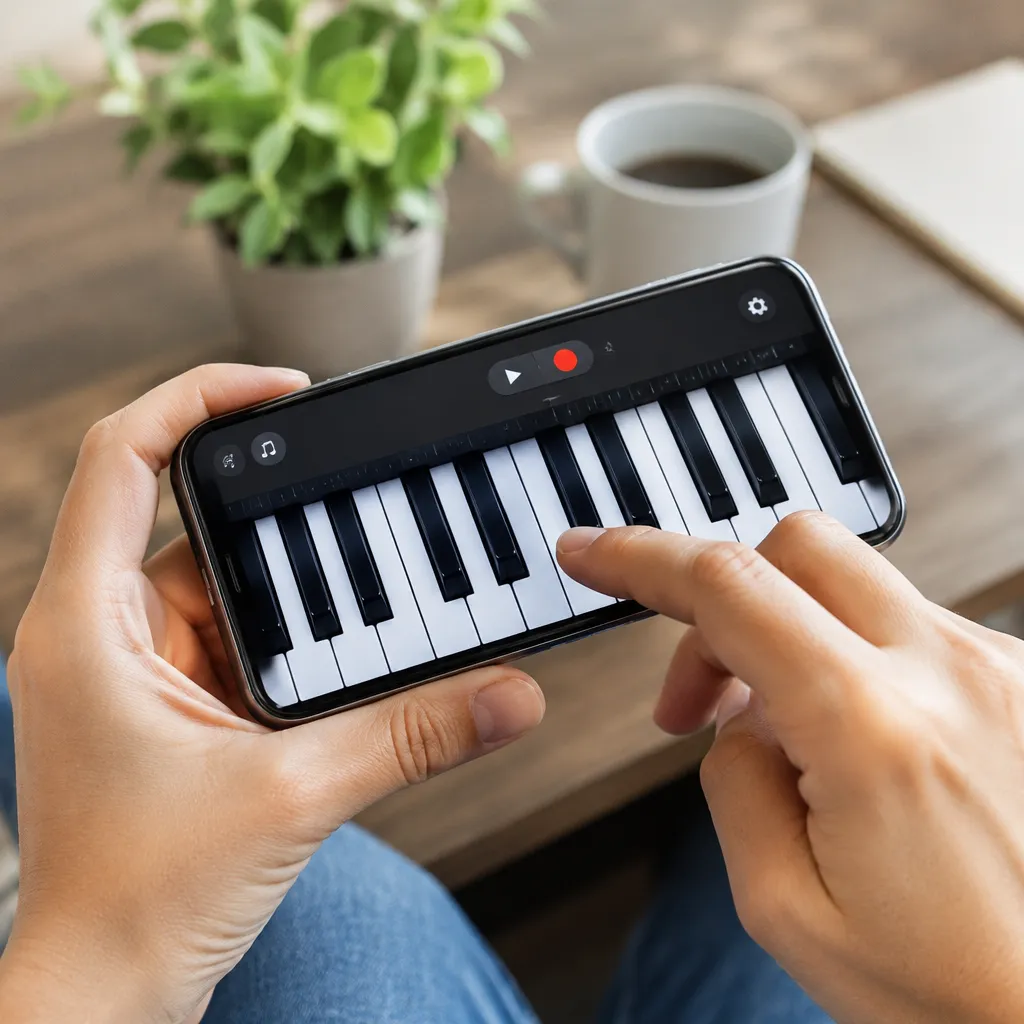
Another common trap is lack of consistency.You start with enthusiasm, practice five days in a row, then go a week without touching, come back hungry to practice too much to “compensate”. This does not work. Your brain does not learn like this; it learns with spaced and consistent repetition. Five minutes every day exceeds an hour once a week. Set a realistic goal: 15 minutes daily is much more effective than committing to an hour that you will not be able to maintain.
Don’t compare your progress with other people’s in the app videos or on social networks. Each person has a different rhythm. Someone who has been playing for two months can play an entire song while you’re still learning notes. This doesn’t mean you’re slow; it means they have different trajectories.
It is also easy to fall into the illusion of being learning just because you are using the app. You need to not only follow, but also reflect on what you have practiced. At the end of each session, pause and think: which notes am I still missing? Which exercise was more challenging? Where do I need to focus tomorrow? This metacognition (thinking about your own thinking) accelerates learning by 30% or more.
Good international practices you can copy
Countries where music apps gain more adoption have common characteristics. First, the culture of continuous learning is strong: people see education as a process that does not end in school, but continues throughout life. This has created demand for affordable and inexpensive educational content.Second, the apps there were designed after researching what users really wanted, not what developers thought they should want.
A specific practice that works well is the weekly challenge system. Instead of just tracking your own progress, you get a new challenge every week (play such music with 90% accuracy, improve your speed by 5%, complete all lessons in the module). These challenges create micro goals that keep you engaged even when the big goal (learning to play well) seems too far away.
Another good international practice is to offer multiple ways to practice the same skill. You do not play the music from beginning to end 20 times; you play small sections, practice isolated chords, follow rhythmic patterns, etc. This variation keeps the brain engaged and avoids the boredom that causes abandonments.Search for applications that offer diversity in the types of exercise, not only repetition of the same task.
There is also a global trend to offer certificates or completion badges.When you finish a module, you receive a digital certificate that you can share. This is not a conservatory degree, but serves as social validation.You can show it to friends, post it on social networks, or simply save it to remember your progress.
Expanding your learning beyond the app
After a few weeks using the app, you can search YouTube videos of teachers who teach piano. Watching different teachers playing the same songs exposes you to variations in technique and interpretation. You realize that there are multiple valid ways of playing, multiple speeds, multiple emotions. This enriches your understanding far beyond the structured lessons of the app.
Participating in online communities of piano learners also accelerates their development.You see people at different stages, discover doubts you had but did not know how to express, receive practice tips that worked for others. The community provides perspectives that an algorithm, however intelligent, can not replicate.
Also consider listening to music analysis. Choose a song you want to learn and look for videos of teachers analyzing its structure, its chords, its rhythm. When you play with understanding of what is playing, instead of just following instructions, the practice becomes much more meaningful and memorable. You are not performing; you are interpreting.
If you have access to a MIDI keyboard, connect to the app and start exploring. Cheap keyboards (200 to 300 reais) have 61 keys and fully functional sind. The screen transition to physical keys is natural if you have already studied the notes in the app. Your fingers already know where the notes are; now you are just learning to press physical keys.
Maintaining motivation in the long run
The initial motivation to learn piano disappears after a few months.What keeps you playing is the visible progression. So it is crucial to choose an app that clearly shows your progress: how many notes you learned, how many hours you practiced, how many songs you master.
Set small, achievable milestones.Don’t wait months to feel good about yourself. Celebrate when you can play an entire song for the first time, when you hit a 30-day practice sequence, when you improve your speed.
Also change the type of music you practice as you go. Start with simple technical exercises, then learn easier popular songs, then explore genres you love.If you like jazz, classical, pop, ambient or any other style, look for apps that have repertoire in that area. Studying what you love is always more motivating than studying what others think you should learn.
Having a colleague learning on the same app creates mutual responsibility.You can share progress, challenge each other, or simply know that you are not alone.This social dynamic is powerful for maintaining the habit when the initial motivation ends.
Learning piano on iPhone with free apps is feasible, practical and pedagogically sound. The key is to choose the app that connects with you, establish a consistent practice routine, and understand that the progression is gradual. You will not play Chopin in three months, but in a year of consistent practice 15 minutes a day, will master a reputable repertoire and will have tools to continue learning alone. Technology has democratized music education; now it depends on you to use this opportunity with discipline and focus.