Detecting Spirits: Common Mistakes to Avoid
Announcements
Have you heard of apps that promise to detect spirits or capture paranormal entities?They are everywhere in app stores, but most don’t work as promised.In this article, we’ll explore the most common mistakes people make when using this type of technology.
Announcements
The search for paranormal tools has grown a lot in recent years, especially with the advancement of smartphones and artificial intelligence. Many users install spirit detection applications expecting scientific results, but end up being disappointed or, worse, spending money on premium versions that do not deliver anything true. Understanding common mistakes can help you make more conscious decisions about these tools.
Confusing Marketing with Scientific Reality
The biggest mistake you can make is believing that a spirit-detecting app operates on the basis of real science.Many of these apps use sensors on your phone (such as an accelerometer, magnetometer, and camera) to generate data that looks deep, but is actually just collecting information about electromagnetic energy, air movement, or light reflections.
Developers know that marketing is powerful, so they use terms like “entity detection”, “spectral frequencies” and “bioenergetic field analysis” to sound credible.You watch a demo video on YouTube, see the app’s camera flashing and a robotic voice saying “entity detected”, and your brain connects the dots believing that something supernatural has actually happened.
Neglecting the Role of Cognitive Expectations and Vieses
When you already believe that you will find a spirit, your brain works against you. This phenomenon is called confirmation bias, and it is extremely powerful when you are using a paranormal application.If the app issues a strange alert, you interpret it as proof of supernatural activity, but if it does nothing, you blame the conditions of the environment or say that the spirit was simply not there at that time.
Pareidolia is another common misconception: your brain is naturally inclined to recognize patterns, especially faces and entities in random data. When you see a wave in the graph of a paranormal detection app, your brain can interpret it as a communication, when in fact it is just natural electronic noise. You are bringing your own expectations into the experience, turning neutral data into “evidence” of something paranormal.
Ignore the Importance of Calibration and Control Testing
You should never use an app to detect spirits without first testing it in normal environments to understand how it behaves naturally. Most people simply open the app, press the detection button and start searching for entities, without any notion of what the default behavior of the app is. This is a critical error that completely invalidates any “evidence” you think you have found.
A true scientific test would require you to use the app in multiple environments with no expectation of paranormal activity, record what results the app produces naturally, and only then compare it to environments in which you actually expect to encounter spirits. If the app generates the same alerts and readings anywhere, regardless of whether you are in a cemetery or in your kitchen, then the results have no real paranormal value.
Checklist: Mistakes to Avoid When Using Spirit Detection Apps
To help you make better decisions, here is a checklist with the most critical mistakes you should avoid when using any paranormal app:
First, don’t confuse smartphone sensors with real paranormal equipment.The sensors on your phone measure temperature, motion, magnetic fields and visible light, but none of this data can demonstrably detect spirits.Before using any app, research what sensors it is actually using and understand their technical limitations.
Second, always test the app in a control environment before using it in places with alleged paranormal activity. Run the app in your living room, your office, your kitchen, and other normal places, and carefully record what alerts and readings you receive. Compare these results with those you get in “haunted” locations to see if there are real differences or if the app simply works the same way anywhere.
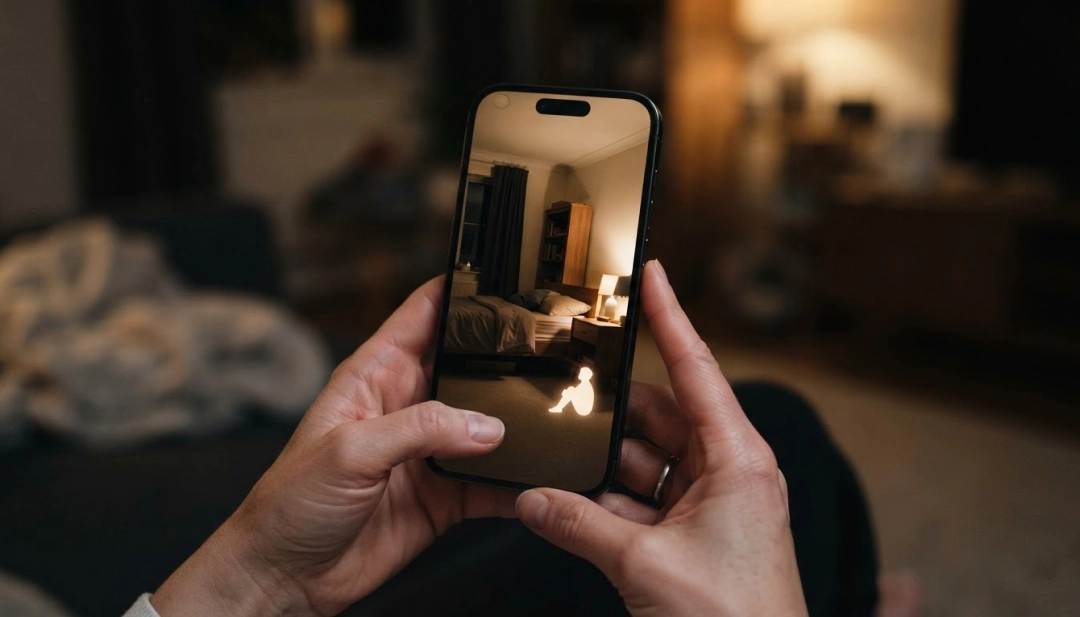
Third, be aware of your own biases and expectations.You are actively looking for paranormal signals, and your brain is tuned to find them. Take a skeptical friend to witness your results, or use video cameras to record what the app detects without your emotional interpretation interfering. Objectivity is essential when you are investigating the paranormal.
Fourth, do not spend money on premium versions or special features of paranormal applications without first testing the free version completely. Many developers know that people desperate to communicate with spirits will pay for anything that looks more advanced, so they create questionable paywalls in their apps.The paid version rarely offers results substantially different from the free version.
Fifth, be wary of apps that don’t explain how they work or that use vague paranormal jargon. A legitimate app should make it clear which sensors it’s using, how it’s processing the data, and what it’s actually measuring. If the developer can’t explain why your app works clearly and technically, probably because there’s no valid explanation to offer.
Sixth, never ignore the possibility that “real” paranormal events may have completely mundane explanations. Strange sounds may be wind, pipe, or animals. Movements may be drafts or old structures moving.Floating temperatures may be air conditioning or sunlight patterns. Always consider these simple explanations before concluding that a spirit is at stake, and use the app only as a first step, never as definitive proof.
Seventh, avoid asking questions to the app or trying to communicate with entities through it as if it were a digital ouija. This amplifies your biases and creates an illusion of real dialogue when in fact the app is just responding to random stimuli. The app can not think, interpret intentions or consciously communicate with you.
Why You Are Vulnerable to These Mistakes
The truth is that we are all vulnerable to magical thinking when it comes to paranormal.This is not weakness of character or lack of intelligence: it is how the human brain was built by evolution.Our ancestors needed to detect patterns quickly, even if it meant sometimes seeing threats where there were none, because failure to detect a real predator was much more expensive than a false alarm.
When you use an app to detect spirits, you are activating exactly those same evolutionary instincts. The app provides stimuli (vibrations, sounds, blinking graphics), your brain processes these stimuli as possible threats or entities, and you experience a real emotional response. You are not being stupid; you are being human. The key is to recognize this process and compensate for it with critical thinking and objective testing.
The Reality About Detecting Spirits with Technology
If you really believe that spirits exist and want to investigate the paranormal responsibly, a smartphone app is definitely not the right tool for the job.Serious paranormal researchers use equipment such as professional electromagnetism detectors, infrared thermometers, digital audio recorders and high-quality thermal cameras, not apps that cost 99 cents in the Google Play Store.
These professional devices still lack proven ability to detect spirits, by the way, but at least measure real phenomena reliably and consistently. An app on your phone, on the other hand, is competing with hundreds of other sensors and processes running simultaneously, including notifications, background apps, and automatic updates.
The wisest way is to recognize that current technology simply cannot reliably detect spirits, regardless of how advanced it is or how many five-star reviews the app has on the market. If you are passionate about the paranormal, take the time to learn about the history of spiritism, read serious paranormal research, and if you want to investigate in person, invest in proper equipment and work with established research groups that use strict protocols.