Crochet for Beginners: See How to Get Started Simple
Announcements
Crochet is a crafting technique that turns yarns into amazing pieces using just a hooked needle.You can create clothes, accessories, decorations and more with simple and relaxing movements. Getting started now is easier than you might think, and this guide will show you exactly where to start.
Crochet offers numerous benefits beyond the end result: it reduces stress, improves concentration and allows you to create personalized gifts for friends and family. Many people discover a genuine passion for this art when making the first point, and soon find themselves producing pieces that once seemed impossible. The crochet community around the world is constantly growing, sharing tutorials, patterns and inspiration daily.
The Essential Materials for Getting You Started
Before anything, you need to gather the basic materials that are affordable and economical. A crochet needle (also called a hook), one or two types of wire and scissors are really all you need to make your first points. There are needles in several sizes, from very thin to very thick, and each works with specific wires & the right combination ensures that your work comes out well proportioned and beautiful.
Announcements
 YarnPal – Crochet p/ beginners
Classification:
”’I think it’S.
4.79
Age Classification:
Free Classification
Author:
PIXELCELL PTE.
Platform:
Android
Price:
Free
▶Download on Google Play
The yarn is the protagonist of your project, and choosing the right type makes all the difference, especially when you are starting out. Cotton yarns are perfect for beginners because they slide well into the needle, allow you to clearly see each point and are much cheaper than other options. You will also need a small scissors, tapestry needle (to close the loose threads), stitch markers (which can be even ordinary pins) and a notepad to note progress.
Understanding the Basics of Crochet
The crochet works on top of a few fundamental points that combine to create all possible patterns. The current point is the basis point of any project, and all other points derive from it. Mastering these fundamentals means that you will have the tools necessary to interpret any pattern and even create your own designs over time.
Download on Google PlayGRATISThe main points you should learn are the current point, the low point, the high point and the double high point. Each of these points creates a different texture and is used in different proportions depending on what you want to do. The low point is denser and firmer, while the double high point creates more open and fluid work. Understanding how each point works and how they relate is critical for you to progress with confidence.
In addition to these main points, there are variations and combinations that you will learn naturally as you go. Points such as increased tidal point, away low point and even shell point will arise in your future projects.The important thing now is to focus on the fundamentals and practice until your fingers understand the movement automatically, without you having to think about each gesture.
How to Make Your First Current Point
The current point is your starting point, and learning to do it correctly ensures that all your next projects have a solid foundation. Start by making a simple knot at the tip of your wire, leaving about 15 centimeters free. Pass the needle inside the knot and pull the wire, forming a loop around the hook.
With the wire passed on the hook, you pull it through the previous turn, creating the first current. Keep repeating this movement ‘pass the wire on the hook and pull it through the existing turn ‘UNTIL to form a chain with the length you want. Consistency is essential here; try to keep the width of your chains uniform, as this makes it much easier when you start working on the next points.
Practice making chains for at least 20 or 30 minutes in a row, as this repetition will train your fingers and your muscle memory. You will probably make crooked or irregular chains at first, and this is completely normal and expected. Each crochet artist goes through this phase, and soon you will be making perfectly straight chains without even thinking about the process.
Maintaining the Correct Wire Voltage
Wire tension is one of the most important concepts you need to master, as it determines the size, firmness and overall appearance of your work. Too loose tension creates large, irregular points that easily break down, while excessive tension leaves the work hard, too small and difficult to continue. The goal is to find a middle ground where you have full control over the wire without forcing it.
You control the tension mainly through the fingers that hold the wire before the hook, not by the hook itself. A common technique is to run the wire over the index finger, then under the middle finger and finally over the ring finger, thus creating a traction system that keeps the tension stable. Experimenting with different positions with your fingers until you find the one that feels most natural is an important part of the learning process.
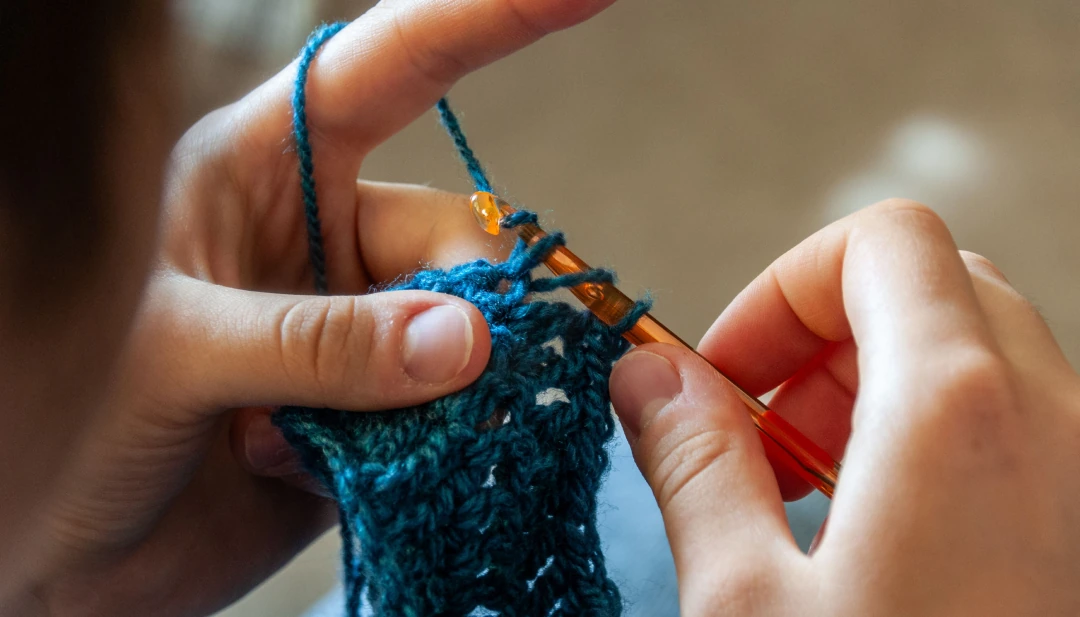
Many people find that doing some warm-up exercises before starting a project helps to keep the tension more consistent. Make chains, lows and highs continuously for a few minutes so that your fingers “understand” how to apply the correct pressure.If you notice that your pieces come out too loose or too tight, do not worry & adjust the tension is a skill that dramatically improves with constant practice.
Common Mistakes and How to Avoid them
One of the most frequent mistakes among beginners is to count the points incorrectly, which causes accidental increase or decrease of points in the row. To avoid this, always mark the first and last point of each row with a point marker. Another common mistake is to work on the wrong turn of the previous point, creating crooked patterns or irregular texture (the important thing is to maintain consistency by always choosing the same turn (usually the upper turn of the point).
Many people also pick up the wrong wire when starting a new row, which causes unwanted holes in the work. To prevent this, always finish a row correctly and make the necessary turning chains before starting the next. In addition, do not pull the wire with excessive force when closing the points, as this causes deformation of the fabric. Remember that the crochet is flexible ‘you can always undo stitches and redo if you make a mistake.
Another important aspect is not to abandon the project if it does not come out perfect in the first attempts. All the experienced crochetteiros made hundreds of imperfect pieces before achieving consistency and quality. Patience and persistence are your best tools now ‘WHevery point you make is a step towards mastery, even if it does not seem so at the moment.
Simple Projects for Your First Steps
After you master the basic points, it’s time to apply your knowledge in real projects that will motivate you to continue. A square scarf made only with low point is the perfect design to start, as it requires only a repeated point and allows you to practice while creating something useful and beautiful. It is also small enough for you not to get discouraged before finishing it.
A second excellent design is a small bowl or basket made with chains and spiral lows. This project introduces the concept of working around and helps you understand how to increase and decrease points intentionally. You can also create simple little flowers using just a few dots and strands of different colors & yarns.
Bracelets, necklaces and even simple caps are also viable projects for beginners who already master the basics.The important thing is to choose projects that have clear instructions and that use only the points you already know. As soon as you finish your first project, you will have not only a tangible piece to feel proud, but also the confidence necessary to try more complex things.
Maintaining Motivation and Evolving Your Technique
Motivation is the fuel that keeps you creating, and there are several strategies to ensure that it does not disappear. Connect with other people who crochet, whether online in communities or in person in local groups, because sharing your progress and receiving positive feedback is incredibly stimulating. In addition, following crochet hashtags on social networks exposes you to endless inspirations and project ideas that you would like to do.
Challenge yourself gradually to learn new points and techniques as your confidence grows. Do not try to skip steps or do very advanced projects too soon, as this can lead to frustration & instead, increase the difficulty gradually and consistently. Celebrate each milestone, whether you finish your first point, your first row or your first complete project, as these moments are really special.
Invest in better quality yarns as you progress and your technique becomes more refined. Premium yarns offer better texture, durability and final finish, which makes your work even more satisfying. Remember also to save your final designs or gift them to special people & see someone using something you created with their own hands is an incomparable feeling that renews your passion for crochet constantly.