Here's how to simulate x ray with your cell phone's camera
Announcements
You’ve probably seen those viral videos showing people using their cell phone camera to “see through” objects, as if they had an X ray in their hand. But does it really work or is it just a digital myth?.
The truth is that your camera can not literally cross solid objects as does a medical X ray equipment. However, there are real techniques that exploit optical and infrared properties to create visual effects that approach this idea. This article unravels what is myth, what is true and how you can experience these possibilities on your smartphone.
The Myth of Perfect X Ray on Mobile
Many popular videos on the internet promise to turn your smartphone into a professional X ray equipment. The reality is quite different. A medical X ray works using ionizing radiation, which penetrates tissues and bones in different ways, creating gray scale images. Its camera does not emit ionizing radiation and does not have this type of technology, so it can not replicate this functionality for real.
Announcements
The big misconception started when some third-party apps came out promising this ability. They do not produce real X ray, but rather use filters and image processing to simulate the visual effect.It is a digital illusionism trick, not an authentic device capability. When you see a video showing someone “seeing” inside a closed box, in most cases it is about editing or applications that simply modify the way the image is displayed on the screen.
What Really Works: Infrared Filters
The most interesting truth is that some modern smartphones have cameras with infrared sensors. It is not exactly an X ray, but offers surprising results in specific conditions. Infrared detects thermal radiation emitted by objects, allowing you to view temperature differences. This does not allow you to see through walls, but works in situations very different from the traditional X ray.
 Xray scan filter cam
Classification:
””^^^^^^^^^^^^^^^^^^
1.59
Age Classification:
Free Classification
Author:
rokdevapps
Platform:
Android
Price:
Free
▶Download on Google Play
You can use basic infrared filters in camera applications to create pseudothermal effects.Some newer phones, especially premium models of well-known brands, have sensors that capture a wider range of the light spectrum.With these cameras, it is possible to photograph objects in complete darkness or reveal certain patterns invisible to the naked eye.It is not yet an X ray, but it works in a completely different way than most people imagine.
Simulating X-ray Effects with Applications
If you want to try the X ray simulation on your mobile, there are applications available that create this visual effect. They work by applying black and white filters, adjusting contrast and brightness, and processing the image in real time. The result may look impressive in short videos, but in practice does not reveal anything that is really hidden.
Applications such as X ray simulators use a simple algorithm: they capture the image of the rear or front camera and apply a filter that reverses colors, reduces intermediate tones and increases contrast. The visual effect is similar to that of a black and white radiograph.Some more sophisticated versions add border distortions or scanning effects to make the simulation more convincing.This works on any smartphone, regardless of the model or brand.
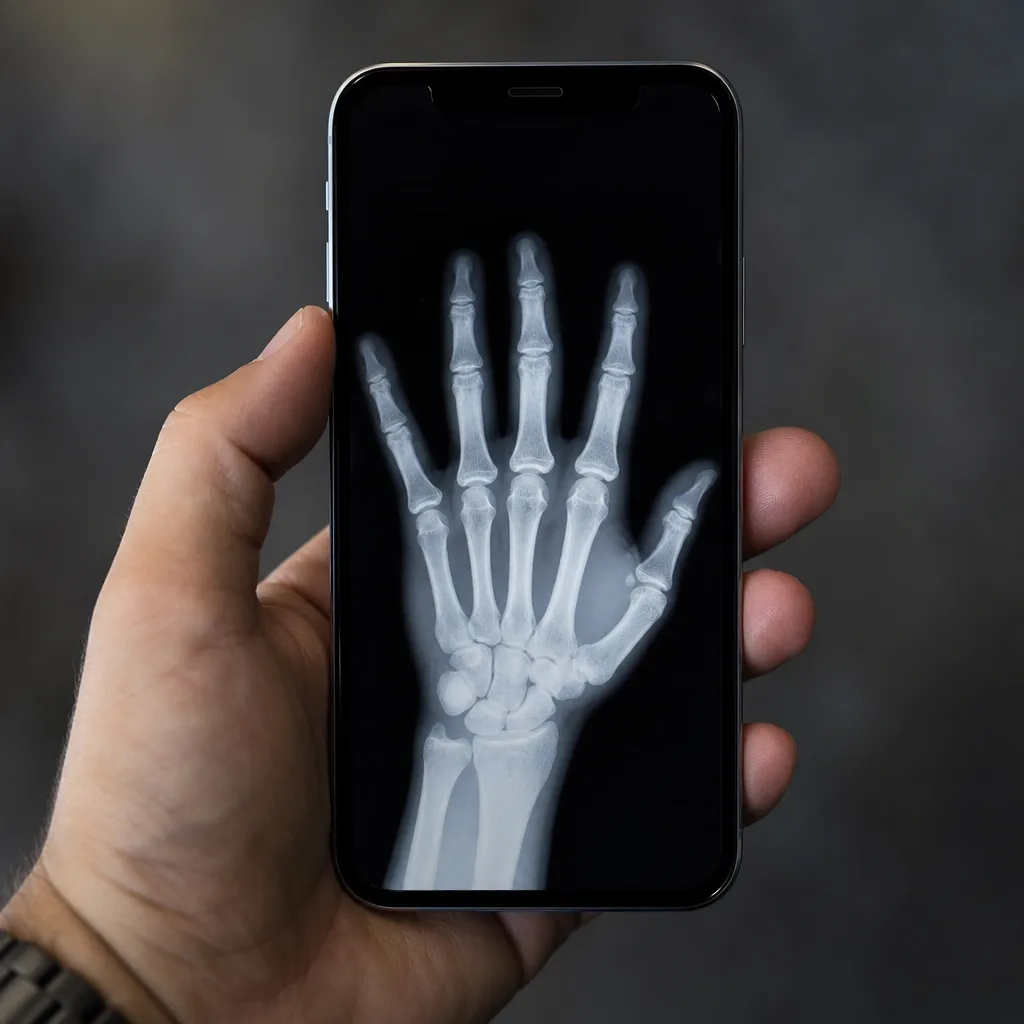
These applications are completely harmless and serve basically as a fun or educational tool.You can visualize surface density differences in nearby objects, creating interesting optical illusions. For example, a hand photographed with these filters may seem to reveal “bones”, when in fact the algorithm only accentuates natural shadows present in the image. It is a good example of how our brain fills missing information based on expectations.
How to Use Thermal Camera (When Available)
Some high-end smartphones have thermal cameras or thermodynamic sensors. If your device is a recent premium brand model, refer to the technical specifications to check this functionality. These sensors actually offer information that an ordinary camera cannot capture, allowing you to view temperature variations in objects and environments.
A thermal camera works by detecting the infrared radiation emitted by hot bodies. You can photograph a wall and see lighter spots where there is greater heat flow or cold areas where there are leaks.Safely, these sensors detect people hidden in dark environments. In maintenance, they reveal problems in electrical installations. This is true technology, quite different from the X-ray simulation, as it provides real data on the thermal properties of objects.
To use this functionality, if your phone has it, you usually access it through the standard camera or enhanced camera app. Some manufacturers include a dedicated thermal mode. The resulting image shows a heat map with varying colors representing different temperatures.The warmer the object, the clearer or more colorful the representation. This is probably the closest tool to a “functional X ray” available on smartphones, although it still does not allow you to see through opaque objects.
Myth: You Can See Through Clothes or Walls
One of the biggest myths about simulating X ray with mobile is the ability to see through clothing or physical barriers. This is absolutely false. No smartphone app or camera can do this, and any video that shows this functionality uses editing, multiple cameras or is simply fabricated. The physics behind it is insurmountable: visible cameras cannot penetrate opaque objects, and apps only process what is already being captured.
Even the thermal cameras available on smartphones can not see through barriers. They only detect heat on surfaces. If you point a thermal camera to a closed wall, you will see only the temperature of the wall itself, not what is behind it. This limitation exists because infrared also does not penetrate solid structures as you might think.It is a wrong concept that persists in many viral videos and dodgy tutorials.
Legitimate Techniques: Visible Spectrum Infrared
There is a legitimate technique that creates X-ray-like effects using near infrared (NIR), which sits at the edge of the visible spectrum.Some smartphones, especially older or modified models, have cameras that can capture this spectral range.With an appropriate infrared filter, you can photograph translucent materials differently from visible light, revealing hidden details.
For example, plastics that appear opaque in visible light can become translucent under near infrared. Certain ink patterns or invisible marks on paper become visible when photographed in this spectral range. Documents with safety verification can reveal elements hidden under infrared radiation. This is a practical and real application of spectral modification, but it is also not an X ray in the medical sense, and is far from the “magical” capability that viral videos suggest.
To experience this, you would need a specific infrared filter (a film or glass that blocks visible light but allows infrared to pass through) and a smartphone with a sensor capable of capturing in this range.Most modern phones deliberately filter infrared to improve photo quality in visible light. Therefore, this technique is more a project of technological enthusiasm than a feature accessible to the average user.
Truth: Night Cameras and Enhanced Night Mode
An often mistaken truth with X ray is the ability of modern cameras in dark environments.The night mode of current smartphones uses advanced processing algorithms, increasing ISO sensitivity and combining multiple exposures to capture images in low light.
This is not X-ray, but it offers a visually similar result in specific situations. If you point the camera at a person in a dark room, night mode manages to capture their details clearly, while with the naked eye you would not see anything.Many people confuse this ability with infrared, but it is only about computational image processing. The smartphone amplifies the signal from the camera and uses noise reduction techniques to produce a usable image.
Well-known brands like Apple, Google and Samsung have greatly refined this technology in recent years. The results are impressive, but again, nothing to do with real X ray. You still can not see through opaque objects or physical barriers.The camera continues to capture only visible light; it only intelligently amplifies it when there is little available. It is an exceptional demonstration of software engineering, but maintains the same physical limitations of any ordinary optical camera.
The Role of Artificial Intelligence in Filters
Many modern X-ray applications use artificial intelligence and machine learning to process images. Instead of simply applying a fixed filter, the algorithm tries to recognize objects in the image and apply specific effects to each element.
For example, an application can use neural network to identify that it is photographing a hand, then apply shadows and contrasts in order to better simulate the appearance of bone radiography. The result is more realistic than a generic X ray filter, although it remains only a visual simulation. Artificial intelligence does not provide real data on internal structures; it only predicts how an radiograph should look based on patterns learned during training.
This is an area where technology has evolved significantly in recent years. Increasingly sophisticated applications manage to create very convincing visual illusions. However, the fundamental premise remains the same: you are seeing creative image processing, not genuine detection of internal structures. AI makes the illusion more beautiful and persuasive, but it does not change the nature of physical limitation.
Practical Experiments: What You Can Really Do
If you want to test these ideas, there are practical experiments that really work. First, download an X ray simulator application from a reliable app store and test with nearby objects.You will see how the filter turns colors to gray scale and highlights edges. Shoot your hand, a plastic object, a sheet of paper. The result will be a convincing visual reproduction, although it will not reveal anything genuinely hidden.
Second, if your smartphone has night mode, enter a dark room and compare the captured image with the live view. The difference is dramatic and demonstrates the power of image processing. You will be able to see details that were invisible to your eyes. This is a valid experiment that shows real technology capability, even if it is not X ray.
Third, if your phone has thermal camera (recent premium model), use it to photograph objects at different temperatures. You will see a heat map that provides real information about thermal properties. Put a hot object near a cold in the thermal image and watch how they appear in different colors.This is the closest technology to a “functional X ray” available on smartphones, as it provides data that you can not see with your eyes.
Privacy and Security Considerations
When we discuss simulating X ray with cell phone camera, it is important to address privacy concerns. Although X ray simulation apps are basically harmless (since they do not actually work), legitimate concerns arise about real infrared cameras.If a smartphone could actually see through clothing or barriers, there would be serious implications for privacy.
Fortunately, physical limitations prevent this. No smartphone camera can see through opaque objects, regardless of the technology used. Any video that suggests otherwise is fabricated or edited. This is a reassuring fact: you don’t have to worry about someone using a smartphone to violate your privacy in this specific way. Real privacy threats involve traditional cameras targeting windows, mirroring front cameras through malicious apps, or collecting metadata, not the magical ability to see through barriers.
That said, be cautious when downloading third-party apps that access your camera. Check requested permissions and user reviews. A legitimate X ray simulation app does not need access to your contacts, files, or location. If an app requests abnormal permissions, it is a warning sign. Protect your privacy through conscious surveillance, not through myths about non-existent technologies.
The Future of Imaging Technology in Smartphones
Camera technology in smartphones continues to advance rapidly.Makers invest billions in research to improve sensors, processing and spectral capabilities.It is likely that in the coming years, more devices will include thermal cameras or advanced spectral sensors.However, the fundamental physical limitations of light and radiation will not change.You will not achieve a perfect X ray in a smartphone because the two use completely different physics.
What can improve is the quality of X ray simulations through more sophisticated artificial intelligence. Future algorithms may be able to reconstruct more accurate images than we expect to see on radiographs, based on patterns learned from millions of real radiographs.
Another possibility is the integration of spectral sensors that work in multiple ranges beyond the visible. This would allow smartphones to capture information that conventional cameras would never be able to, creating new types of photography and diagnostic possibilities.The real revolution will not be in simulating X ray, but in adding totally new ways of visualizing the world through sensors and processing.
Unmasking Viral Videos
You’ve probably seen that viral video where someone “sees” through a closed box or wall using an X ray app. How are these videos made?The answer is simple: editing, camera tricks, and deception. A content creator can film an object inside the box separately, then edit the video clip to make it look like they’re seeing through it with an app.
Other techniques include using two cameras (one on the front showing the app, one on the back capturing what’s in the box), real infrared light (which needs special equipment, not an app), or simply there’s nothing in the box to start with. When you see a person “seeing” a coin inside a closed envelope, usually the coin isn’t there.
These viral videos work because they explore two things: our willingness to believe in technological magic and the power of visual cue. When you expect to see a coin through an envelope, your brain tends to accept visual cues that support this conclusion. It is the same principle behind traditional illusionism. The magician does not need real magic; he just needs your attention directed incorrectly.X ray video creators use the same trick, but with digital editing.
Real Alternatives for Practical Applications
If you need a real tool for diagnosis or inspection, there are real devices available. Genuine portable thermal cameras can be purchased for reasonable price for professional or advanced amateur use. Apps that use your smartphone’s thermal camera (if available) offer real and non-simulated functionality.For structure inspection, electrical troubleshooting or maintenance, these tools actually work and are appropriate.
For educational or curiosity purposes, X ray simulators remain valid entertainment.They demonstrate concepts of image processing and how algorithms can transform visual data.As a pedagogical tool for learning about real radiographs or how images are processed, they have value. Just do not confuse with functional technology that can be applied for serious purposes. Knowing the difference between simulation and reality is essential to make informed decisions about technology.
If you are interested in exploring the limits of mobile photography, immerse yourself in genuine infrared photography, advanced night photography, or even spectral sensor technology. These are real applications of camera capabilities that you can learn and experience.The knowledge gained will be genuinely useful and you will avoid being fooled by fake videos and exaggerated promises that seem too good to be true.