App to Weigh Cattle with AI by Mobile
Announcements
You’ve probably heard that artificial intelligence revolutionizes everything, including agribusiness.But can a mobile app really weigh your cattle accurately using only camera and AI?Let’s separate the myths from the truths about this technology that is transforming modern livestock.
Announcements
Most breeders still believe that weighing cattle requires expensive electronic scales, fixed structures and a lot of manual work. However, the reality is quite different: there are solutions based on computer vision that can estimate the weight of the animal through the image captured by the cell phone. This technology is not science fiction, but a practical application of machine learning that already works on Brazilian farms.
Myth: AI app fails to replace traditional scale
This is perhaps the biggest myth about AI weighing applications. Many breeders think that the electronic scale is irreplaceable because it offers absolute measurements.However, modern applications are not intended to completely replace the scale, but offer a practical alternative for continuous monitoring.The application works by capturing a photo of the animal at a specific angle and processing data such as body length, height at the withers and chest girth through algorithms trained with thousands of cattle images.
The accuracy of these applications has improved significantly in recent years. Studies show that the margin of error can be between 5% and 10%, which is acceptable for many practical uses such as weight gain tracking, decision to send to slaughter and sanitary control. For commercial sales purposes, you can still use the traditional scale, but for daily farm management, the application offers speed and practicality that no fixed scale can provide.
Truth: The technology works through visual analysis and mathematics
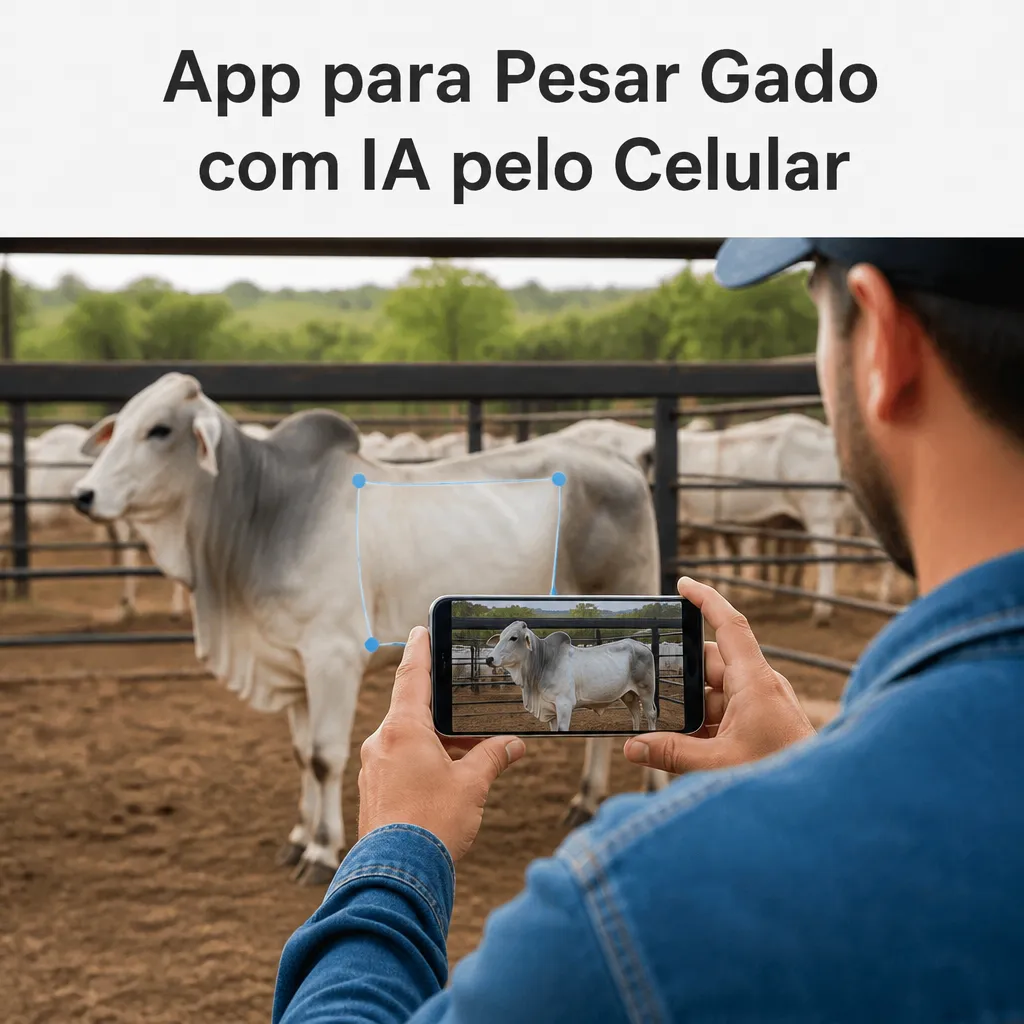
The mechanism behind the operation is simple but effective. When you take a picture of the animal with the application, artificial intelligence identifies reference points in the body of cattle, such as shoulders, ribs, hindquarters and limbs. These points are processed through mathematical models that correlate body measurements with actual weight. The system has been trained with hundreds or even thousands of images of cattle with known weights, creating a pattern that can now predict the weight of new animals.
 Animal Weight – Pigs and Cattle
Classification:
^^^^^^^^^^^^^^^^^^^^^^^”’
3.70
Age Classification:
Free Classification
Author:
HorDev
Platform:
Android
Price:
Free
▶Download on Google Play
This process works because there is a biomechanical relationship between the dimensions of a bovine body and its total weight. Larger animals, with greater thoracic perimeter and body length, naturally weigh more. AI algorithms capture this relationship and apply it in real time during the photographing. The application processes the image in seconds and returns an estimate, saving the time you would spend to gather the cattle, move it to the scale and wait for the measurement.
Myth: Quality of the cell phone camera compromises measurements
Many breeders fear that using the mobile phone for this function will result in inaccuracy, especially if the device has a low-quality camera. This myth does not fully correspond to reality. The most developed applications work well with medium smartphone cameras, not requiring top-of-the-line devices. What matters most is the quality of lighting, the correct angle of capture and the position of the animal during the photo. A mobile phone with a 12-megapixel camera is widely sufficient for AI processing.
Artificial intelligence has been specifically trained to deal with image quality variations.It can interpret photos taken in less ideal conditions because its algorithms are robust enough to compensate for small distortions. Naturally, a well-lit photo with good sharpness and the animal in the correct position will always result in better estimates, but you do not need a state-of-the-art smartphone to get useful results in the day-to-day of the farm.
Truth: The app dramatically speeds up batch monitoring
If you work with large-scale cattle breeding, you know that monitoring the development of tens or hundreds of animals is extremely time-consuming with traditional methods. An AI weighing application solves this problem by allowing you to take quick photos of several animals in a row and get instant estimates. This speed increase has a direct impact on decision making, allowing quick adjustments to feeding, supplementation and handling of batches.
In practice, you can monitor the progress of an entire batch in a matter of minutes, something that would take hours with conventional methods. This efficiency allows you to quickly identify which animals are gaining weight properly and which may be in poor health or nutrition. In addition, you create a visual and numerical history of each animal, facilitating comparisons over time and helping in the genetic selection of the herd.
Myth: AI app is too expensive technology for small creators
There is a widespread perception that artificial intelligence technology is luxury available only for large agribusiness operations. This view is outdated. Many AI weighing applications have affordable models, with free options or low-cost subscriptions that reach a few tens of reais monthly. For the small creator, the investment is practically none compared to what he would spend on electronic scales infrastructure.
A well thought out application offers immediate value even for those who work with few animals. The cost of implementation is zero, since you use the mobile you probably already have. There is no installation, complex technical maintenance or periodic calibration as occurs with electronic scales.Inclusive, some applications offer freemium plans, allowing you to thoroughly test the tool before deciding whether you want a paid version with additional resources. For small farmers, this accessibility represents a real democratization of agricultural technology.
Truth: Data generated feeds selection and nutrition decisions
In addition to providing an estimated weight, a good app generates longitudinal data that you can use to make better decisions in breeding. By recording the estimated weight of animals over weeks and months, you get a growth curve that shows weight gain rate, feed efficiency and response to changes in management. These data are pure gold for those who work with serious livestock. You can identify which supplementation is working, which feed produces better results and which genetics performs better in your herd.
Most apps allow you to export comparative reports and charts between animals and periods. This facilitates conversations with veterinarians, nutritionists, and consultants working with your farm. You present concrete growth data instead of visual impressions. Breeders using these apps report better control over feed costs because they can adjust rations based on real weight gain data. This data-driven approach turns livestock farming into something more scientific and less empirical.
Myth: AI makes a lot of mistakes in different breeds and types of cattle
A frequent argument against using AI applications is that the system was trained with few types of cattle and does not work well with different breeds or crosses. This concern was grounded in the past, but the applications have evolved significantly. The best systems have been trained with images of several bovine breeds, including Nellore, Angus, Dutch, Simmental, Brahman and numerous crossbreeds.The greater the breed diversity in the training data, the more robust the AI model.
Apps developed specifically for the Brazilian market, where we have a wide variety of breeds and crosses, tend to work particularly well in our context. You can test the application with your own animals before committing to any subscription. Most offer a free trial period where you can measure this performance. Even if there is a slightly greater margin of error in a less common breed, the gain in speed and frequency of monitoring still compensates for any small inaccuracy.
Truth: Proper capture conditions are key
To get good estimates using an AI application, you need to respect certain technical conditions of capture. The animal must be in the correct position, usually standing and in full side profile. The lighting must be natural or sufficient for the camera to capture body details clearly. The specific capture angle varies depending on the application, but usually needs to be standardized to ensure consistency in measurements. These requirements are not whimsy, but mathematical need of image processing.
When you follow the application’s guidelines on angle, distance and lighting, estimates improve significantly. Some applications include real-time guidance through the camera, showing exactly how to position the animal to capture the best image. This ease of use makes the process accessible even to people without technical knowledge. Most breeders can master the correct technique after capturing two or three images, developing intuition about the ideal conditions in their specific environment.
Myth: App depends on constant internet to work
There is a common fear among farmers that using a mobile app to weigh cattle requires a permanent internet connection, something not always available on remote farms. This concern is partially valid, but many applications have already solved this problem. Some work offline, allowing you to capture photos and generate estimates without connection, synchronizing the data later when the internet is available. This functionality is crucial to enable use in areas with inconsistent signal coverage.
Even applications that require connection to process AI in the cloud work well because the processing is fast, requiring only a few seconds online. You capture the photo, upload it for processing in the cloud and receive the estimate in seconds. If the connection drops immediately after, you already have the result stored on your mobile. Many creators report success using this approach even in areas with weak 3G, because uploading a simple image requires very little data bandwidth. It is important to check the specifications of the application you choose to confirm its offline operation.
Truth: Maintenance is minimal compared to electronic scales
Traditional electronic scales require regular maintenance, periodic calibration, constant cleaning and can easily break in agricultural environments. A mobile application does not have these demands. You simply install it, update when new versions come out and continue using without concern. There are no mechanical parts that wear out, there is no calibration required, and the probability that the application will “break” during use is practically zero. This operational simplicity saves you time and money that you would spend on technical maintenance.
The only “maintenance” required is to keep your smartphone in good condition, something you probably already do anyway. There are no recurring repair costs, spare parts or specialized technical service. This makes the application an extremely practical solution for creators who want to reduce operational complexity.In addition, when a version of the application becomes outdated, you simply upgrade to the new version, often with improvements in accuracy thanks to new AI trainings.
Myth: AI technology in weighing apps is still immature
Some breeders dismiss this technology as experimental or immature, imagining that it has not yet achieved sufficient reliability for practical use on farms. The current reality contradicts this view. AI weighing applications are already being used commercially in hundreds of Brazilian farms, with users reporting good results and high satisfaction. The technology has gone from an experimental phase to a phase of real adoption in the agricultural market. Companies recognized in agribusiness have already integrated these solutions into their animal management platforms.
The maturity of the technology is evident in the available benchmarks, the feedback of real users and the continuous improvement of the algorithms. Each new version of a well-developed application incorporates learnings from thousands of new images, making the system progressively more accurate. The market would not be investing in development of these applications if there were no real demand and concrete results. You are adopting a technology that has already proven its value, not a questionable experiment.
Truth: Integration with other agricultural management tools is possible
AI weighing apps do not work in isolation. The best of them integrate with broader agricultural management platforms, allowing you to consolidate weight data with health, reproduction, feeding and management information into a single system. This integration is powerful because it turns loose numbers into actionable insights. You can correlate weight gain with changes in diet, with drug application, with climate change and with reproductive events.
Many applications offer APIs or connectors that allow you to export data to tools you already use, such as specific livestock management software or control spreadsheets. This flexibility ensures that the application fits into your existing workflow, not the other way around. You do not need to change your entire management methodology to adopt the new weighing technology. On the contrary, you incorporate it as another component, adding value to your already established information system.
Myth: Single photo is enough to estimate weight with total accuracy
Some users imagine that a simple photo, taken without much attention, will provide an accurate estimate of weight. This expectation is unrealistic and does not correspond to how the technology works. AI is powerful, but not magical. A wrong angle photo, with poor lighting or animal in abnormal position will result in inaccurate estimation. The system needs adequate visual information to process correctly. You can not simply photograph the animal from the front, from above or randomly and expect reliable result.
The best approach is to capture multiple images with different angles and proper position, allowing the application to analyze multiple perspectives and provide an average. This methodology increases reliability significantly. Think of the application as a tool that requires correct use to work well. When you learn the right capture techniques and follow them consistently, the estimates come out accurate and repeatable. This consistency is especially important for monitoring weight changes over time.
Truth: Data history allows trend analysis
One of the biggest benefits of using a digital app for weighing is the possibility of storing complete data history. You can, over months and years, compile a database of information about how each animal grew, how it responded to different managements and feeds, and what its performance indicators were. This history is invaluable for serious breeders who want to continuously improve their results. You identify patterns, best performing stations and individual response of each genetic.
Trend analysis also allows prediction. Knowing how a batch has grown in the past, you can estimate when it will be ready for slaughter or for breeding. You can plan feed investments based on historical weight gain data under different scenarios. This predictive ability reduces uncertainties and risks, making your operation more predictable and more profitable. Creators who regularly use this data report better decision making and greater control over financial results.
The weighing technology with artificial intelligence for cattle via mobile is neither myth nor fiction. It works, offers real practical value and is within the reach of any breeder who wants to improve their management.The myths exist because the technology is relatively new and there is still a lot of misinformation circulating. However, when you understand how it works and its real limitations, it is clear that it is a genuinely useful tool for modern agribusiness. Testing on your own is the best way to understand its specific value on your farm.