
Free App to Estimate the Weight of Cattle!
Announcements
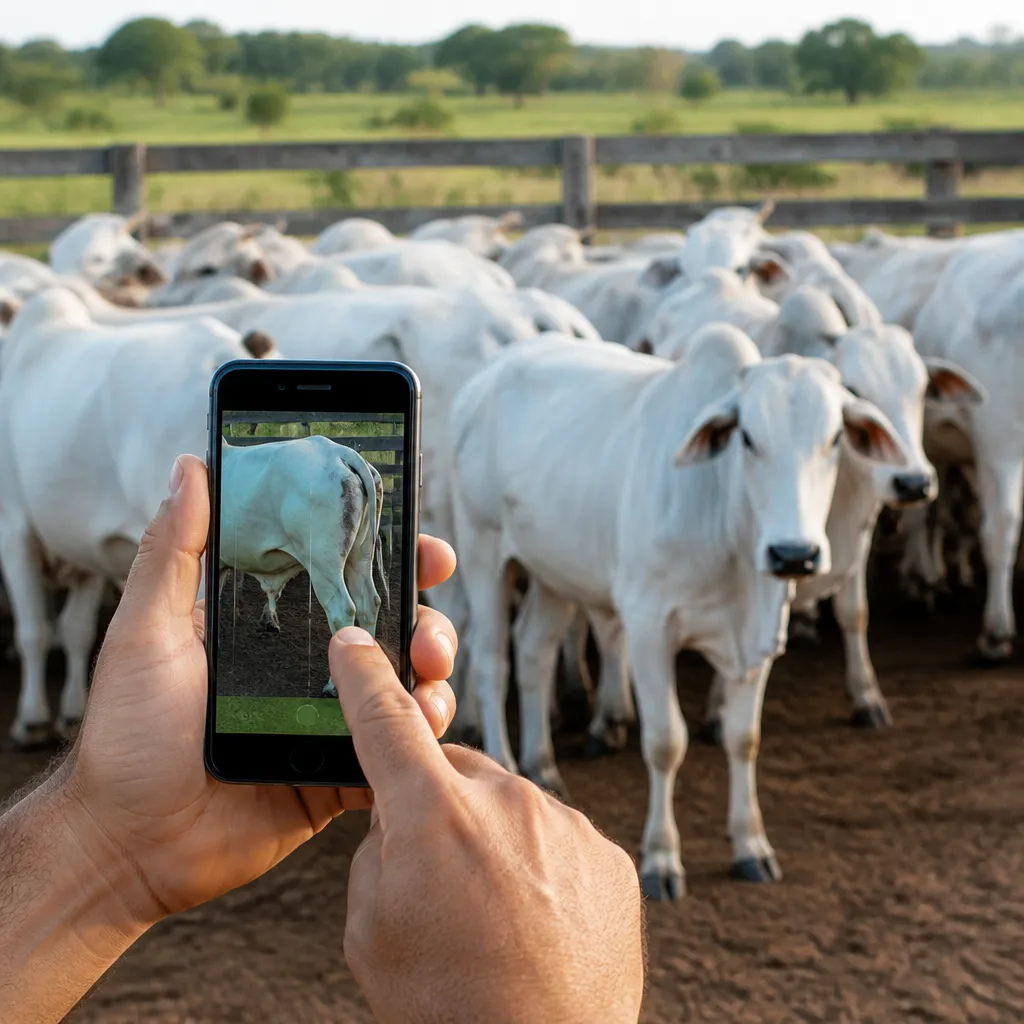
Estimating the weight of cattle is an essential task in livestock, but you do not always have access to accurate scales or feel the need to invest in expensive equipment. Fortunately, free applications can help you calculate the weight quickly and practically, using only physical measurements of the animal and affordable technology.
Announcements
In this article, you will discover how these applications work, what are the best options available on the market and how to integrate this tool in your day-to-day work with the herd.We will explore real use cases, from small properties to larger operations, showing how this technology transforms livestock management.
Why Estimating Cattle Weight Is Important for Your Operation
The weight of cattle directly influences critical economic decisions: when to sell, how much to invest in food, and how to monitor the health of the animal. You need this information to optimize financial return and ensure that the herd is developing as expected. Without accurate data on weight, it is difficult to assess whether nutrition is adequate or whether there are health problems that need immediate attention.
Many ranchers face practical limitations: distance from commercial scales, transportation costs and animal management, as well as possible weight loss during displacement. When you use an estimation tool, it saves time, reduces stress on the herd and avoids unnecessary costs. This practicality is especially valuable on rural properties where infrastructure can be limited.
How Weight Estimation Apps Work
The free applications to estimate cattle weight use a mathematical formula based on specific body measurements. The most common is the measurement of the chest girth (also called abdominal girth), which is one of the most reliable measures to predict the total weight of the animal. You measure a tape measure around the chest of cattle, just behind the front legs, and insert the value into the application.
 Ox Weight
Age Classification:
Free Classification
Author:
Cairo Technology
Platform:
Android
Price:
Free
▶Download on Google Play
Ox Weight
Age Classification:
Free Classification
Author:
Cairo Technology
Platform:
Android
Price:
Free
▶Download on Google Play
In addition to the thoracic perimeter, some applications request additional measures such as body length or height at the withers. This information is processed by algorithms that take into account the breed, age and sex of the animal to offer a more accurate estimate. The technology behind this is not complex, but is quite effective when the measures are taken correctly.
The accuracy of these applications depends a lot on how you perform the measurements.If the tape is crooked, too tight or too loose, the result will be inaccurate. Therefore, many applications include tips on how to measure correctly and offers video tutorials so that you understand the process. When used well, an estimation app can offer error margins between 5% and 10%, which is considered acceptable for most livestock operations.
Real Use Cases: How Cattle Ranchers Apply This Technology
A small family farm in the interior of Sao Paulo used an estimation application to monitor the development of pasture-raised calves. The producer performed monthly measurements and recorded the data in the application, generating a history that allowed to identify if the growth was within the expected. This simple practice helped to detect animals with lower development early and adjust nutrition as necessary.
In another situation, a farmer from Mato Grosso used the application before taking his animals for sale at auction. By estimating the weight in advance, he was able to better price his offer and negotiate more confidently. No longer needed to pay formal weighing fees on commercial scales every time he wanted to check the progress of some animals.
A farm manager in Goias implemented the use of an estimation app as a sanitary monitoring tool.When an animal had abnormal weight loss between measurements, this signaled a possible health problem.The app therefore acted as an early warning for veterinary interventions.This proactive approach reduced disease losses and improved the overall well-being of the herd.
Key Features You Should Look For
When choosing a free app to estimate weight, you should consider whether it allows you to create individual profiles for each animal. This functionality is essential to maintain measurement history and track development over time. Some apps allow you to identify animals by earring number, name or photo, making it easier to organize and retrieve later data.
Another important feature is the ability to generate reports and graphs that show the evolution of weight. You can see if the animal is gaining weight as expected or if there is any slowdown in growth. This data is valuable for decision making about feeding, reproduction or disposal. Some applications also allow you to export this information to spreadsheets, facilitating more complex analyzes.
The intuitive interface is critical so you don’t spend time learning how to use the app. Many ranchers work in the field, sometimes with limited connectivity, so offline ease of use is a big differentiator.Search for apps that work without continuous internet and synchronize data when the connection is available. Support for multiple breeds is also important, as different types of cattle have different body proportions.
Accuracy and Limitations: What You Need to Know
No weight estimation app is 100% accurate, and you need to understand its limitations.The mathematical formula used is based on average data from bovine populations, but each animal is unique. Genetic variations, nutrition, health and even the time since the last meal can influence body measurements.So use the app as a tracking tool, not as an absolute substitute for a scale when necessary to make critical sales decisions.
Very thin or very fat animals may have less accurate estimates, as the formula assumes an average body condition. You can improve accuracy by taking measurements regularly and calibrating your estimates against occasional actual weighings.If a particular app always overestimates or underestimates weight relative to the scale, you learn to make mental adjustments or rely more on changing trends than absolute values.
The quality of the measurement depends entirely on you. If it is not consistent, takes measurements at the correct location or keeps the tape at the proper angle, the results will be questionable. Many experienced ranchers develop skill in this task with practice, and this is reflected in increasingly reliable estimates. Train your technique and consider measuring the same animal twice to check consistency.
Integrating the Application into Your Livestock Routine
To get the most out of a weight estimation app, you should establish a regular measurement routine.Many growers do this monthly for growing calves, or every three months for adult animals. Choose a range that makes sense for your operation and maintains consistency. Schedule measurements on specific days, preferably at the same time, to minimize variations caused by rumen filling or other daily fluctuations.
Organize your herd information in the app clearly and in a standardized way. Use names or consistent numbering, photograph animals for visual reference, and keep notes on important events like calving, disease, or nutritional changes.These contextual notes help you interpret weight changes more informedly. If the herd is large, consider using tags and categories to target animals by batches or developmental phase.
Share data with your team members if you work with other managers or veterinarians. Some applications allow you to export reports that can be sent as a file. This facilitates communication and ensures that everyone has access to the latest information. On larger properties, this data transparency contributes to more coordinated and efficient decisions.
Available Apps and How to Choose the Best for You
There are several free apps available in the app stores that offer weight estimation functionality for livestock. Each has its particularities in terms of interface, additional features and compatibility with operating systems.You should test some of them to find out which one best aligns with your needs and workflow.Some apps are simpler and more straightforward, while others offer a full suite of livestock management tools.
When evaluating an app, consider whether it offers technical support or an active user community. You can find tutorials, ask questions, and learn best practices from other ranchers who use the same tool. Also check the frequency of updates: an app that is maintained regularly is more likely to continue working with new versions of smartphones. Read reviews from other users, but remember that experiences vary depending on the context of each property.
Start by testing an application with a small group of animals or during a trial period. This allows you to learn how to use the tool without pressure and make sure it really adds value to your operations. After gaining confidence and understanding the flow, you can expand to the entire operation.Do not be afraid to switch to another app if the first does not meet your expectations, because the important thing is to find a solution that works for you.
Practical Tips for More Precise Measurements
The quality of measurements is decisive for the accuracy of estimates. You should always measure in the same place of the animal’s body: the thoracic perimeter should be taken immediately behind the front legs, horizontally to the ground. Use a flexible and resistant tape measure, never rigid. The tape should be firm, but not tight to the point of deforming the animal’s body or leaving marks on the skin.
Try to measure in similar conditions whenever possible. Ideally, take measurements at the same time of day, a few minutes after the animal has moved so that the rumen is not completely full or empty. Animals that are very agitated or stressed can have variable measures, so take time to leave them calm. If you are going to use a containment, keep the animal straight and in a neutral position, not tilted forward or backward.
Record all measurements in the app immediately after performing them, while the data is still fresh. Add notes about any abnormal condition: the animal was sick, had eaten little, or was in heat? These contexts help interpret later reading. Check the sequence of values: if an estimate is drastically different from the previous one for no apparent reason, redo the measurement to confirm.
Financial Benefits of Using Weight Estimates Regularly
Consistent use of a weight estimation app can result in significant savings over time. You reduce costs with transporting animals to commercial scales, eliminate frequent weighing fees, and improve sales timing.When you know the approximate weight of the animal, you can better negotiate auctions or direct transactions, avoiding speculation.
In addition, weight monitoring contributes to more efficient nutritional management. You quickly identify if weight gain is below expectations and can adjust the eating plan before significant losses occur. This is especially important in intensive breeding, where nutrition accounts for a large part of operating costs. Animals that gain weight as expected reach the point of sale faster, optimizing the capital invested.
From a health perspective, regular weight monitoring works as an indicator of herd health. Abnormal weight loss alerts you to potential problems before they become critical. Early interventions cost much less than advanced disease treatments or complete animal losses. Producers who adopt this practice report noticeable improvements in zootechnical indices such as feed conversion rate and days to slaughter.
Adapting Technology to Different Types and Sizes of Ownership
Owners of small farms with 50 to 100 head of cattle can use the application more simply, measuring each animal manually and recording the data. This approach is feasible and still offers significant benefits of monitoring and control. The time spent is less, but the added value is great, as you have full visibility into the development of each animal.
In average operations with hundreds of animals, organization becomes crucial.You can segment the herd by lots and make sample measurements of a few representatives from each group instead of measuring all. This reduces the time required while maintaining useful information about overall performance. Sharing work between multiple employees speeds up the process, provided that everyone is trained properly.
Large properties with thousands of animals often combine estimation applications with more sophisticated livestock management systems. The app remains useful for field monitoring and rapid decision making, but can be integrated with weighing data at a larger scale. Some industrial-scale producers use the app to detect anomalies or validate automatic weighing data, creating an additional layer of quality.
Data Synchronization and Backup: Protecting Your Information
Any digital tool you use to store information about the herd should have robust data protection mechanisms.You should check whether the application offers automatic backup option in the cloud or allows you to export data in an accessible format.Losing months or years of weight records for phone failure would be frustrating and detrimental to trend analysis.
Prefer applications that automatically synchronize data with secure servers. Thus, even if the smartphone has problems, your information is protected and can be recovered on another device. Some apps offer synchronization via user account, while others use cloud. Any of the options is valid, as long as it is reliable and easy to use. Make manual backup occasionally, exporting data to spreadsheet or document, just to be extra sure.
Keep your data organized and label it so you can retrieve specific information quickly. Create folder structures or categories that make sense for your operation.If you work with multiple smartphones on the farm, make sure everyone is using the same account or there is clear synchronization between devices to avoid duplication or loss of information.
Team Training: Ensuring Consistent Application Use
If your team is going to use the app, invest time in proper training. Show step by step how to perform correct measurements, how to use the app and how to record data in a standardized way. Create simple documentation with photos or screenshots showing the process. The more intuitive the method for your employees, the better the adherence and quality of information.
Establish clear protocols: who measures, at what frequency, at what time and how it records. Inconsistencies in these practices lead to questionable data. Offer incentives or recognition to employees who maintain the data collection routine consistently well.
Perform periodic evaluations of application use: is the data being collected? Does the records make sense? Do employees understand how to use the tool? Make adjustments when necessary and provide constructive feedback.If you identify recurring difficulties, it may be that the chosen application is not the most suitable for your team, and a change is justified.
Comparison Between Weight Estimation and Professional Weighing
Weighing on scales is more accurate, especially digital platform scales, which offer margin of error less than 2%. However, this is only an advantage if weighing cost and logistics are feasible. Many small and medium-sized ranchers find that regular weighing is not economically justifiable, while estimating offers superior cost-benefit. Use professional weighing occasionally to validate their estimates and calibrate their confidence in the application.
Frequency is also different. You can measure with app on normal work days, while formal weighing requires commuting and scheduling. This means that with an app you collect much more data, allowing for finer tracking of weight changes. More data points result in more reliable analysis and more informed decisions, even if each individual point is a little less accurate.
The ideal solution for many ranchers is to combine the two approaches: use the application for routine monitoring and weighing for strategic validation at key moments such as before sale or batch evaluation.This hybrid model offers precision when it really matters and practicality in everyday life. You gain benefits from both technologies without paying the total cost of continuous weighing.
Integration with Other Livestock Management Tools
Some weight estimation apps work best when integrated with other livestock management tools. You can synchronize weight data with nutrition, health and reproduction records, creating a complete picture of the life of each animal. This integration allows for more sophisticated analysis: correlating weight gain with type of feed, or with a history of diseases.
If your property already uses a specific livestock management system, check for compatibility with weight estimation apps. Some more complete systems have their own modules for estimation, while others allow third-party data import. Compatibility greatly facilitates workflow and reduces manual data transfer work between platforms.
Also consider data analysis tools and spreadsheets. A well-chosen application should allow you to export your data to formats such as CSV or Excel. This gives you flexibility for later customized analysis.If you are knowledgeable in data analysis, you can create custom dashboards and reports that go beyond what the application alone offers.